Maybe you’ve heard the advice to run slow to run fast, and it sounded unbelievable then too, but I ran an experiment on myself, and here are the results: I ran 1:28:30 at the Balaton Half Marathon according to my Garmin, a 4:12/km (6:46/mile) average, while most of my runs are closer to 6–7:00/km (9:40–11:15/mile) than to 5:00/km (8:03/mile).
I should add that I can run 4:00/km (6:26/mile) over a very short distance without any training, but in the last month I set personal bests in the 10k and the half marathon at age 50, while I almost never run that fast. What I did was train more, and more consistently, than ever. My weekly mileage is about 50 km (just over 30 miles), and I also ride another 12–17 hours, plus some swimming and kayaking.
Run Slow to Run Fast: What My Training Looked Like
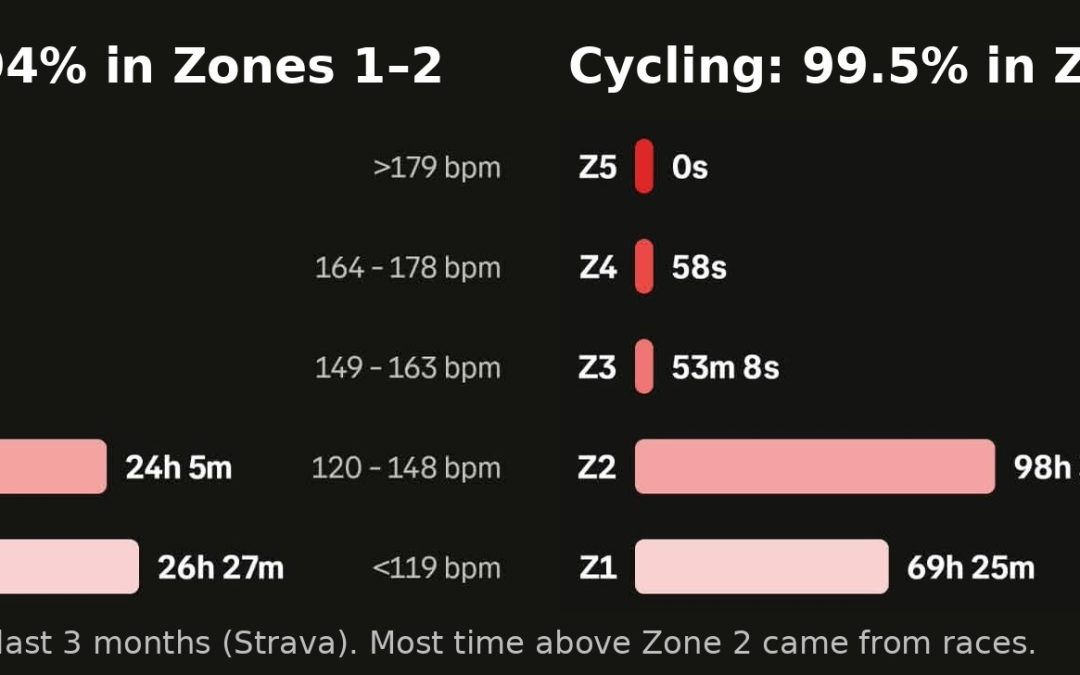
That adds up to around 20 hours a week. I train almost every day, but very lightly. The two Strava screenshots show that 99.5% of my riding was in Zones 1–2, and of about 50 hours of running, only 3 were above those zones, most of them in the 10k and half-marathon races. In training I went above 150 bpm for only about an hour on foot and an hour on the bike. Out of 220 hours! So my training is 98% easy plodding, around 1% at 150–160 bpm, and 1% at threshold or above.
[INLINE IMAGE: run-slow-heart-rate-zones-arnold-method.jpg]
If you’ve made it this far through the numbers, it’s worth checking your own training. If more than 20% of it is in Zone 3 and above, or above 80% of your maximum heart rate, and you’re not preparing for a sprint, you may be missing a lot of room to improve. A study of recreational runners pointed the same way: over ten weeks, those who spent very little time in the middle zone improved their 10k a bit more than those who spent a third of their training there, although the difference wasn’t conclusive. One caveat: I train about 20 hours a week, so my split isn’t a recipe for someone with four. What carries over is the principle: keep most of your training easy enough to recover from by the next morning.
How to Try This With 4–5 Hours a Week
If you train four or five hours a week, you don’t need my volume to test the idea. For the next four weeks, keep every run below the top of your Zone 2, which for me is 148 bpm, even if that means walking the hills. Once or twice a week, after two or three slow kilometres, add one faster kilometre or a few hundred metres, and ease off as soon as your heart rate reaches the top of Zone 2. Keep one longer run a week, and let a race or a parkrun be your hard day. After a month, run the same route at the same heart rate and compare your pace.
How I Hide Fast Running Inside Slow Runs
Of course, things aren’t that simple, because I cheat sometimes. One of my secrets is that I hide the more intense running inside a slow run. I run 3 km slower than 6:00/km (9:39/mile), then 1 km at 4:00/km (6:26/mile), and my heart rate doesn’t reach 150, so I’m running race pace, already warmed up, at a low heart rate. After that comes a walk or some very slow running, and then another few hundred metres at 4:00–4:30/km.
Not often, maybe once or twice a week, sometimes less. So it’s not that I never run fast. I just very rarely push my heart rate really high. Cycling is similar. I might push a climb in a big gear at a low cadence, and my legs start to burn before my heart rate climbs. Or I ride a steady 135–140 bpm for half an hour and then easy for two hours, on knobby tyres, so my average ends up around 25 km/h (15.5 mph), and anyone glancing at it would just shrug, while the load was there.
Effective Training Doesn’t Collect Kudos
Effective training isn’t logging a massive, kudos-collecting workout on Strava. It’s the small everyday loads you can recover from by the next morning. It doesn’t always have to be the same sport, because the heart and lungs don’t know what you’re doing, but your tendons do. So far I’ve had two milestones, beating my 10k and half-marathon PBs at 4:08 and 4:12/km (6:39 and 6:46/mile). The next challenge will be a bit easier: sometime during the winter school holidays, a run of at least 30 km at 5:00/km (8:03/mile), with my heart rate in Zone 2, which is a maximum of 148 bpm and ideally below 140. The biggest challenge is my weight, and eating is one of the places where long, slow, consistent work doesn’t help.
If you want a structured way to approach this
The Sleep Reset eBook breaks this process down into a clear, step-by-step system. Instead of guessing what matters, it gives you a framework to stabilise your sleep pattern over a short period.
Questions People Ask
Does running slow really make you faster?
For many recreational runners, yes. Keeping most runs easy lets you train more often and more consistently without piling up fatigue, and that volume builds the aerobic base that race pace depends on. A small amount of faster running still matters; the point is that it stays a small part of the week.
How slow is slow enough?
Slow enough that your heart rate stays in Zone 2 or below for the whole run, which often means walking uphill. You should be able to talk in full sentences. For many people that pace feels embarrassingly slow at first.
How much of my training should be easy?
Research on endurance athletes usually points to around 80% easy and 20% harder. With high training volume, the easy share can be much bigger. If more than a fifth of your training sits in Zone 3 or above, it’s worth looking at.
Can I run fast without a high heart rate?
For short stretches, yes. A fast kilometre or a few hundred metres after a slow warm-up can stay below your Zone 2 ceiling, because heart rate takes time to rise. Ease off as soon as it reaches the top of the zone.