
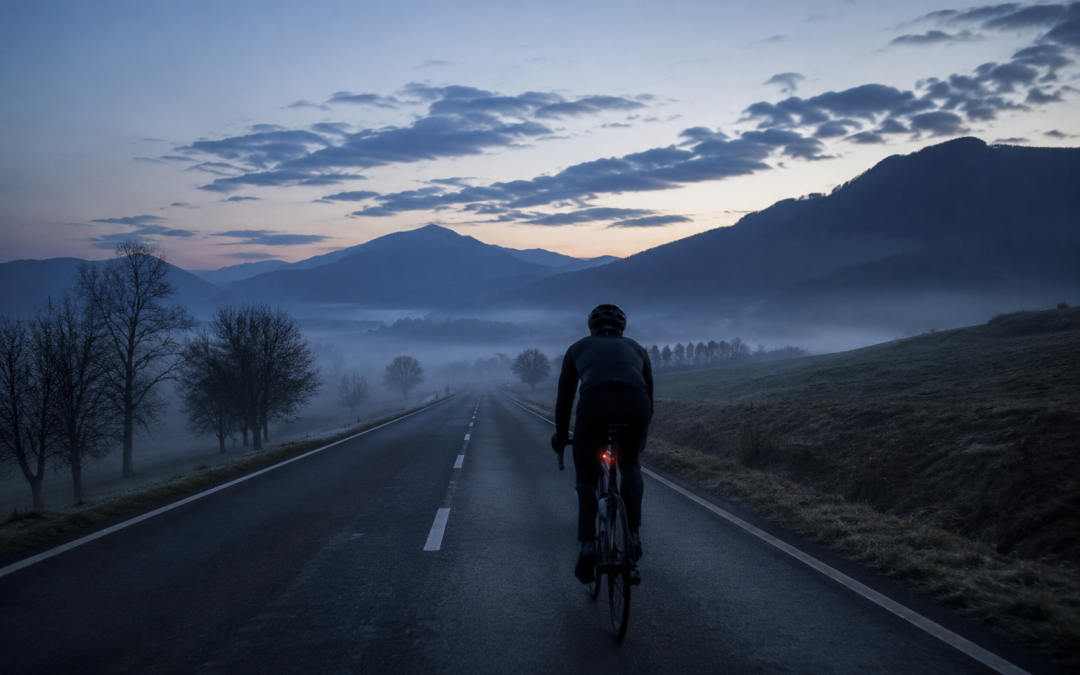
About nine years ago I decided it was time to take quadrathlon seriously, and up to that point just finishing had already felt like success — but I knew my competitors were training fifteen-plus hours a week while I was under ten, and with a baby son at home and a full-time corporate job, there weren’t many places left to find that time. So I turned motivation into discipline, and discipline meant waking up between five and six. It would take me most of a year to understand the difference between time in bed versus sleep, and what forcing one without the other actually costs.
The Day That Built Around It
The day built around that: breakfast, first training session, work, second training session, time with my son, reading him to sleep, and once he was down, whatever time was left was mine — reading, a film, whatever I wanted. Sleep never really entered my thinking about recovery, though food did, lighter training weeks did, stretching did, and a rest day every second or third week, sure. I never measured my sleep — I just assumed that spending close to seven or eight hours in bed had to be enough.
Falling Asleep With My Son
A few weeks into the new discipline, training started feeling gradually heavier — I had to cut volume, then intensity, and none of it made much sense on paper, because I was just tired, really tired, tired enough that on weekends I started sleeping through my son’s noon nap right alongside him. On weekdays, more and more often, I fell asleep with him at eight in the evening, and getting up afterward, doing anything, then lying awake for another hour before actually falling back asleep, felt harder than just staying down, so I made it easier on myself and shuffled from his bed to mine half asleep, never fully waking up in between.
At the time none of this felt like information — it felt like weakness. I wasn’t reading in the evenings anymore, wasn’t studying, wasn’t doing any of the things I thought a disciplined person should still be doing after everyone else went to bed. I was just falling asleep like a child, and I judged myself for it, even wondering at one point if I was getting sick.
The Pattern I Almost Missed
It took a while before I noticed the actual pattern: on the days when I didn’t force myself to stay awake, I could actually do the training, and the difference wasn’t subtle — I could get through a session that had felt impossible a few days earlier, simply because I’d stopped fighting the sleepiness the night before. That mattered more than my pride did, so eventually I just kept sleeping next to my son.
Even working as a trainer myself, it wasn’t obvious to me that what I was calling discipline might actually be part of the problem — I thought I was making the most of the limited hours available to me, when in reality I had created an extra hour or two of life by taking it from the one thing I hadn’t been counting.
The whole thing started right after race season, in early September, with the weekend naps coming first, and by winter I’d made the eight-to-nine p.m. bedtime a deliberate choice rather than something that just kept happening to me — I stopped trying to get back up after putting my son to sleep, and if I was tired, I went to bed, which sounds embarrassingly obvious now.
What It Actually Cost, and What Fixed It
The daytime cost carried on for a while after that. I was still sleepy at work and caught myself scrolling instead of sitting down properly with a spreadsheet, and my digestion, which normally worked almost to a schedule first thing in the morning, became unpredictable for a while too — I didn’t connect that to sleep at the time, and I can’t say now that sleep was the only reason. But by late winter, once the early bedtime had become fixed rather than something I fell into by accident, the whole thing had settled down: I was less sleepy during the day, work was easier to start, and training stopped feeling like something I had to drag myself through.
One of the mistakes I made was treating time in bed as if it were the same thing as sleep, when it isn’t — you can spend eight hours between getting into bed and getting out of it and still get considerably less actual sleep, especially if you take a long time to fall asleep, wake during the night, or spend the last part of the morning lying there half awake because getting up feels impossible. I had never checked any of that; seven or eight hours in bed sounded like enough, so I assumed it was.
Nine years later, the eight-to-nine p.m. bedtime is just built into my life, and in my forties, evening social events are rare enough that there’s enough buffer in the system to absorb the occasional late one without much cost. It still looks strange to plenty of people that I go to bed like a kid, though the recent heat waves have made that decision look even less strange — I have no trouble training before the worst heat arrives, because I was already awake anyway.
And I don’t think I became less disciplined — if anything, I eventually got better at training because I stopped using discipline to override information my body was already giving me.
It was never the early starts that were the problem. It was calling it discipline when really I’d just cut my own sleep and let my body send the bill later.
If you want a structured way to approach this
The Sleep Reset eBook breaks this process down into a clear, step-by-step system. Instead of guessing what matters, it gives you a framework to stabilise your sleep pattern over a short period.
Frequently asked questions
Is it safe to shift your wake-up time earlier by an hour or more all at once?
Not without shifting bedtime too. Moving wake time earlier while keeping the same bedtime simply shortens the sleep window, and the body usually can’t compensate for that on its own — the deficit tends to show up as daytime sleepiness, harder training sessions, or difficulty concentrating within a few weeks.
What’s the difference between time in bed and actual sleep?
Time in bed includes time spent falling asleep, waking during the night, and lying there before finally getting up — none of which counts as sleep. Sleep efficiency, the ratio of actual sleep to total time in bed, is often lower than people assume, especially for anyone who takes a while to fall asleep or wakes frequently.
Can poor sleep cause digestive irregularity?
There’s a plausible connection, since sleep and digestive rhythms are both regulated by related biological clocks, but it’s difficult to isolate sleep as the single cause in any individual case. It’s reasonable to notice the pattern without claiming certainty about the exact mechanism.
Is falling asleep early every night a sign of a health problem?
Not necessarily — for some people it reflects a consistently early chronotype or a sleep debt catching up with them, and once the debt is repaid or the schedule stabilizes, the early collapse often resolves on its own. It’s worth paying attention to if it’s new, sudden, or paired with other symptoms, but a stable early bedtime by itself isn’t inherently a red flag.