

Why Understanding Your Sleep Problem Is Not Enough?
Most people who struggle with sleep already understand their sleep problem. They know they wake too early, or can’t switch off, or wake up tired despite enough hours. They’ve read about circadian rhythm, sleep pressure, cortisol, blue light. They’ve tried things. Some of it helped — up to a point.
Understanding your sleep problem is not the same as fixing it. That distinction took longer to act on than most people expect — including me. This is what the gap actually looks like, and what it takes to close it.
The difference between information and structure
Information about sleep is widely available and largely accurate. The problem isn’t access to knowledge — it’s that knowledge alone doesn’t assemble itself into a working system. You can understand exactly why morning light matters, why caffeine timing affects melatonin, why consistent wake time outperforms consistent bedtime — and still not sleep well, because understanding each piece separately is not the same as having them working together in the right sequence.
The moment this became undeniable for me was accidental. During a period of early morning fitness training — same time every day, outside, facing east, fifteen minutes of concentrated movement before anything else — sleep stabilised in a way it hadn’t in years. I hadn’t designed it as a sleep intervention. But I had accidentally created the right structure: consistent timing, morning light exposure, physical engagement, and mental focus, all compounding together rather than happening occasionally and separately.
The individual elements weren’t new information. The sequence was. And sequence, it turns out, is most of what matters.
Why most attempts don’t hold
The typical pattern looks like this: try one change, wait for an immediate result, don’t see it clearly enough, move on to the next thing. Each individual change may be correct — earlier bedtime, reduced caffeine, morning movement — but tried in isolation, without enough consistency for the effect to compound, none of them produces the result the research suggests they should.
This is the recipe problem. Having the right ingredients is not enough. Adding them in the wrong order, or substituting freely before you’ve followed the recipe once properly, produces a different result than the method intends. One skipped step, one week of inconsistency before the structure has set, and it falls apart the first time life pushes back — a stressful week, a run of late nights, travel. You conclude the approach doesn’t work rather than that the structure never fully formed.
According to the Sleep Foundation, sleep hygiene improvements require consistent application over several weeks before measurable changes in sleep architecture occur. Most people abandon the attempt within days of an inconsistent result — long before the structure has had time to set.
What structure actually requires
Building a sleep system that holds requires three things that information alone cannot provide: a defined sequence, a long enough commitment to see compounding effects, and enough understanding of the mechanism to know what to protect when life disrupts the routine.
The sequence matters because the inputs to sleep quality are not independent. Morning light exposure affects evening melatonin production. Caffeine timing affects sleep pressure. Training load affects nervous system recovery. These don’t operate separately — they interact. Changing one without understanding its relationship to the others produces unpredictable results and makes it difficult to identify what’s actually working.
The commitment matters because most sleep improvements are not immediately visible. The compounding effect of consistent inputs — same wake time, morning light, appropriate training load, managed caffeine, genuine evening wind-down — takes two to three weeks to show clearly in sleep quality and daytime energy. Most people evaluate results in days, which is too early to see the effect and too early to make useful adjustments.
The mechanism understanding matters because life will always disrupt the routine. Travel, illness, stress, late nights — these are not failures of the system, they are inputs the system needs to be able to absorb. A stable sleep system doesn’t prevent disruption — it provides something solid enough to return to afterward.
What closes the gap
At some point, explanation stops being useful on its own. The articles on this site cover the mechanisms in detail — why you wake at 3am, what wired-but-exhausted actually means, how remote work disrupts sleep rhythm, what tracking actually tells you, why the morning matters more than the evening. That understanding is real and useful. But it is an ingredients list, not a recipe.
What I tried to build at arnoldmethod.com is the recipe — the sequence, the reasoning behind each step, and the order that seems to matter most for men whose sleep has been inconsistent long enough that the pattern feels normal. The eBook covers the structure: what sleep actually needs, why the usual approaches fall short, and how the inputs connect. The 21-day program is the same structure applied over long enough to hold — not a protocol to follow indefinitely, but a baseline to build from and then adjust to your own rhythm.
Understanding why something works is not the same as having it work. If the articles here have made sense of the problem, the next step is building something around it.
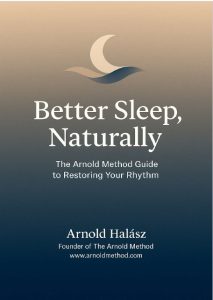
If you want a structured way to approach this
The Sleep Reset eBook breaks this process down into a clear, step-by-step system. Instead of guessing what matters, it gives you a framework to stabilise your sleep pattern over a short period.
Frequently asked questions
Why doesn’t sleep advice work even when I follow it?
Most sleep advice addresses individual habits in isolation — earlier bedtime, no screens, cooler room. These inputs are real but they interact with each other, and applying them separately without a defined sequence rarely produces the compounding effect the research describes. The issue is usually not the advice itself but the absence of a structure that holds the pieces together long enough to work.
How long does it take to see results from sleep changes?
Most measurable improvements in sleep quality and daytime energy require two to three weeks of consistent application before they show clearly. Evaluating results in the first few days — which is when most people abandon the attempt — is too early to see the effect. Consistency over the full period matters more than perfection on any individual day.
What is the difference between the eBook and the 21-day program?
The eBook covers the structure of sleep and the role each input plays — it is the understanding layer that explains why the sequence matters. The 21-day program is the sequence itself: specific steps, in order, applied consistently long enough for the structure to hold on its own. The eBook costs $9 and that amount is credited toward the program if you decide to continue.
Is this relevant if I already know a lot about sleep?
Knowledge of sleep mechanisms is useful but it is not the same as having a working system. Most people who struggle with persistent sleep issues already understand the problem reasonably well — the gap is structural, not informational. The program is designed for people who have tried individual changes without lasting results, not for people who are starting from zero knowledge.
Enjoy every single day