

I remember lying in bed one evening feeling strangely alert, despite being physically exhausted from training earlier that day. The last coffee had been hours ago — four, maybe five — so caffeine didn’t even cross my mind as the explanation. I just assumed it was one of those nights.
It took a while before I connected the two.
For most of my adult life, I didn’t drink coffee. Not as a health decision — it just wasn’t part of how I functioned. I was well into my forties before that changed, and what changed it was simple: energy. Not dramatic fatigue, but the familiar afternoon drop where focus starts to slip and things that should be easy start to feel heavier. One coffee helped. Then it became occasional, then regular, then daily, and then something I planned around — before training for the performance effect, after training when I had mental work ahead, sometimes in the afternoon when things were slowing down again.
The caffeine and sleep disruption built gradually and wasn’t immediately obvious.
The part caffeine and sugar play together
The sugar was always there in the background. As an endurance athlete, sweet drinks before and during training are normal — isotonic drinks, gels, bars, extra sugar that the muscles clear quickly during effort. That part made sense and I never questioned it.
What I didn’t pay enough attention to was applying the same logic to desk work. Sweet coffee while working gives the same spike, but without the muscle activity to process it. The crash is real, the temptation to reach for another follows, and the whole thing runs later into the day than it should.
I wasn’t overconsuming caffeine. I was misapplying what I already knew about sugar and energy, in a different context. The two were tangled together long enough that it took removing one to see what the other was actually doing.
What the sleep data was showing
I go to bed around nine — early by most standards, but aligned with how I train and how my body actually runs. What I started noticing was that some nights I couldn’t settle into that. Not dramatically awake, just a feeling of readiness, like the body still had something left to do. Too tired to move, but not calm enough to drop.
Sleep came later than usual, and when I checked my tracker in the morning — I monitor sleep score and HRV through the night — the data confirmed what I’d felt. Less deep sleep, more interruptions, and the familiar signs of sympathetic dominance: elevated heart rate, heat, sweating, with no change in room temperature to explain it.
My first instinct was not to blame caffeine, because my last coffee was rarely after four or five in the afternoon, and that didn’t feel late. But the mechanism is not what most people think.
This is also the physiological state behind what gets called the wired but exhausted pattern — physically depleted, nervous system still running. Caffeine timing is one of the more common and least obvious drivers of it.
How caffeine actually affects sleep — the adenosine mechanism
Caffeine doesn’t just stimulate. It works by blocking adenosine receptors. Adenosine is the chemical that builds up throughout the day and creates sleep pressure — the biological signal that tells your body it’s time to wind down. Caffeine doesn’t reduce that adenosine, it just blocks the receptors so you can’t feel it accumulating.
When those receptors are still blocked in the evening, melatonin can’t build the way it should. The system that’s supposed to be preparing you for sleep is being held in a more alert state than it should be at that hour — not because you drank too much, but because the timing pushed the block into the wrong part of the day.
The half-life of caffeine is typically five to seven hours. A coffee at three in the afternoon still has half its effect at eight or nine in the evening. Most people significantly underestimate how long caffeine remains active in the system — which is why the cutoff time matters more than the quantity.
If the result is waking during the night rather than difficulty falling asleep, the 3AM waking guide covers what is happening at that stage — including how blood sugar and cortisol interact with the same window that caffeine disrupts.
How I rebuilt the habit on different terms
The reset came indirectly. I started cutting sugar — partly because I was picking up weight, partly because I wanted to understand what each thing was actually doing. Removing one made it easier to look at the other clearly. A week without caffeine confirmed that I actually liked the effect and wanted to keep it — but on different terms.
I rebuilt the habit from scratch. One strong coffee in the morning, one lighter one after training, something minimal around lunch if needed, nothing that counts after early afternoon. The rule is not rigid — some days none, some days more if training demands it — but the cutoff is firm. By evening, there is nothing in the system blocking the wind-down.
The sleep score shows it. The HRV shows it. And the feeling of already gravitating toward bed two hours before I actually get there — that’s the clearest sign the timing is right.
Caffeine is not the problem. It’s a tool with a timing requirement that most people, myself included for a while, quietly ignore.
Getting the timing right is one part of stabilising the evening wind-down. The broader picture — how the sleep system responds to daytime inputs — is covered in the sleep system guide. If the bedroom environment is also keeping the nervous system activated later than it should be, the sleep environment guide covers what to address there.
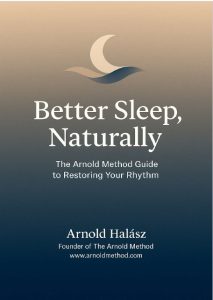
If you want a structured way to approach this
The Sleep Reset eBook breaks this process down into a clear, step-by-step system. Instead of guessing what matters, it gives you a framework to stabilise your sleep pattern over a short period.
Frequently asked questions
How does caffeine affect sleep quality?
Caffeine blocks adenosine receptors — adenosine being the chemical that builds sleep pressure throughout the day. When those receptors are blocked in the evening, the body cannot feel the accumulated sleep drive, and melatonin production is suppressed. The result is difficulty falling asleep, lighter sleep stages, and less restorative deep sleep — even if you feel tired enough to sleep.
What is the best caffeine cutoff time for better sleep?
For most people, stopping caffeine by early to mid afternoon — roughly twelve to fourteen hours before the intended sleep time — is enough to clear the active effect before the body’s wind-down process begins. Given caffeine’s half-life of five to seven hours, a coffee at 3pm still has significant active effect at 9pm. Individual metabolism varies, but earlier is consistently safer than later.
Can one coffee in the afternoon really disrupt sleep?
Yes, particularly if your natural sleep window is early or if your caffeine sensitivity is higher than average. The disruption is rarely dramatic — it tends to show up as slightly delayed sleep onset, reduced deep sleep, or mild night waking rather than obvious insomnia. This makes it easy to miss the connection, especially if the coffee felt fine at the time.
Does sugar combined with caffeine make sleep disruption worse?
It can, particularly when the combination produces a blood sugar spike followed by a crash later in the day. The crash triggers a cortisol response that activates the nervous system at the wrong time — compounding the adenosine-blocking effect of caffeine. For endurance athletes or anyone using sweet drinks for energy, the timing and context of consumption matters as much as the quantity.