
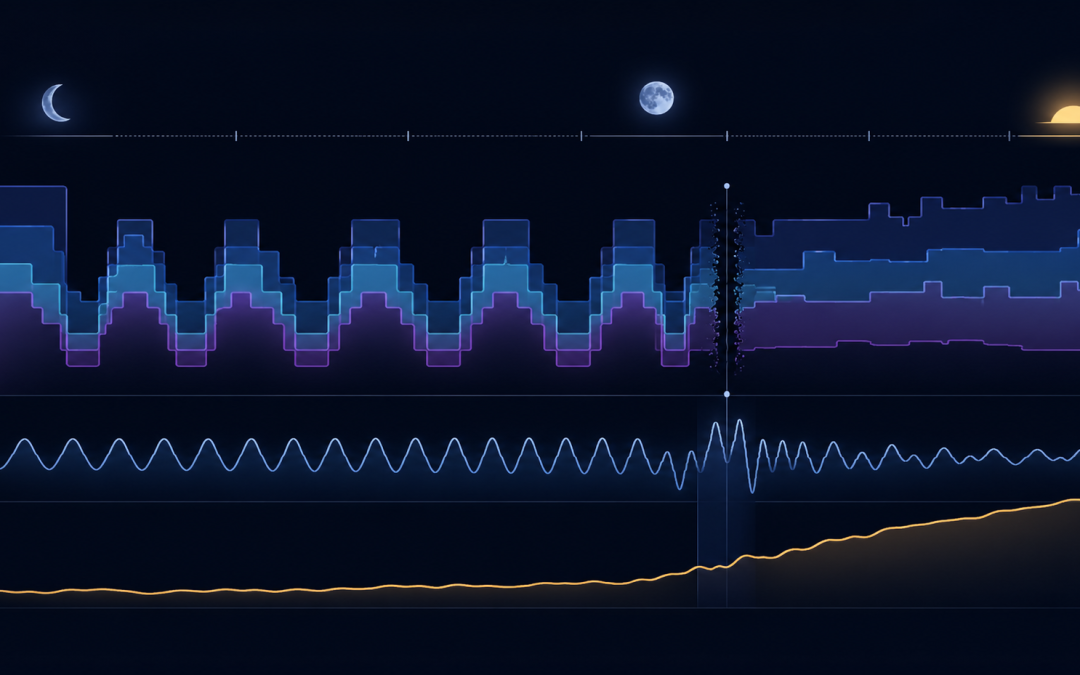
Waking up at 3AM has a specific pattern to it. It is rarely the kind of brief disturbance where you turn over and fall back asleep. In many cases, you wake up fully alert, with the sense that your body has already shifted into a more active state.
When this starts to happen repeatedly — often at almost the same time each night — it stops feeling accidental. The consistency suggests something else: a process that is unfolding in a predictable way.
In most cases, waking up at 3AM is not random — and if you find yourself asking why you wake up at 3AM night after night, the answer usually lies in how your system transitions through the night, not in a single trigger.
The 3AM wake-up is part of a transition, not an interruption
Sleep is not a single continuous state. It moves through cycles, coordinated by circadian rhythm, hormonal timing, and nervous system balance.
In the early morning hours — roughly between 2AM and 4AM — your body begins a gradual transition toward waking. Cortisol starts to rise, body temperature begins to shift, and the nervous system becomes slightly more active.
Under stable conditions, this transition remains invisible. You stay asleep, and by the time you wake up later, the process has already progressed in the background.
When the system is less stable, this is the point where sleep tends to break.
Why you wake up at 3AM at the same time each night
The consistency of the timing is often what makes this pattern feel unusual. Waking up at the same hour night after night can feel almost mechanical.
But this reflects how the body works. These processes are timed. Earlier in the night, sleep pressure is stronger and the system is more resilient. As the night progresses, that pressure decreases, and sensitivity increases.
By the early morning hours, relatively small imbalances are enough to interrupt sleep. The wake-up itself is not caused by something that suddenly appears at 3AM. It is the point where underlying conditions become visible.
The main patterns behind 3AM waking
There is rarely a single cause. More often, several factors combine in the same time window.
Cortisol timing shifts
If cortisol rises too early or too sharply, the body moves toward wakefulness sooner than it should. Research on cortisol and sleep shows this often happens without obvious daytime stress, which is why it frequently goes unnoticed.
Blood sugar instability
During the night, your body still requires a stable energy supply. If blood sugar drops too much, the body compensates by releasing cortisol and activating the nervous system. The result is a clear, often alert wake-up.
Chronic background stress
Not acute stress, but a slightly elevated baseline over time. Sleep becomes lighter, transitions become less stable, and the early morning window is where this instability tends to appear first.
Inconsistent sleep timing
Irregular sleep schedules reduce the precision of your internal clock. Hormonal signals become less predictable, and transitions that would otherwise be smooth begin to fragment.
This is a system pattern, not a single problem
When this pattern becomes regular, it is not useful to treat each wake-up as an isolated issue.
Most attempts to fix it focus on the moment itself — breathing techniques, supplements, or trying to force sleep to return. These can reduce the intensity, but they rarely change the pattern.
The reason is simple. The wake-up is not the problem. It is the result of how the system is currently set up.
If the system remains unchanged, the pattern tends to repeat.
This is also what drives the wired but exhausted pattern — where tiredness and alertness exist at the same time because the underlying rhythm hasn’t been addressed.
What actually needs to change
Improvement comes from stabilising the conditions that allow sleep to remain continuous.
In practice, that usually involves:
- consistent sleep and wake timing
- reducing late-day stimulation
- supporting stable energy availability overnight
- aligning light exposure and activity with your internal rhythm
None of these elements is complex on its own. The difficulty is that they need to work together. Isolated changes often feel ineffective because they address only one part of a multi-part system.
The environment where you sleep plays a direct role in this. The sleep environment guide covers the specific adjustments that reduce friction in the body’s recovery process.

If you want a structured way to approach this
The Sleep Reset eBook breaks this process down into a clear, step-by-step system. Instead of guessing what matters, it gives you a framework to stabilise your sleep pattern over a short period.
Frequently asked questions
Is waking up at 3AM a sign of something serious?
In most cases, no. It is more often a sign of a dysregulated sleep system than an underlying medical condition. If it is accompanied by other symptoms such as pain or breathing difficulties, it is worth medical evaluation. Otherwise, it is typically a pattern issue.
Why does it happen at exactly the same time?
Because the underlying processes are timed. The early morning transition is the point where sleep pressure is lower and the system is more sensitive, so imbalances tend to appear consistently at that point.
How long does it take to improve this pattern?
With consistent changes to sleep timing and daily structure, improvement often begins within a few weeks. Full stabilisation depends on how long the pattern has been present and how consistently the system is reset.
Can stress cause waking at 3AM even if I feel calm?
Yes. It is not always about conscious stress. A slightly elevated baseline level of nervous system activation can shift hormonal timing and make early morning waking more likely.
Seen that way, it becomes less of a random disturbance and more of a pattern that can be understood. And once a pattern is understood, it can be changed.
If you are looking for a broader starting point, the sleep system guide explains how circadian rhythm, sleep pressure, and nervous system balance work together.