
The routine I built for the wrong reason entirely — and why it worked better than anything deliberate.
I chose that time of day for the wrong reason entirely.
The fitness trainer exam was getting closer and I was nervous. I can follow a pace — running, cycling, kayaking, swimming — anything where I set the rhythm myself. But choreographed movement to music, keeping up with a beat, hitting the right position at the right moment: that is a different thing entirely. I wasn’t good at it and I knew it. So I picked the one window when no one would see me.
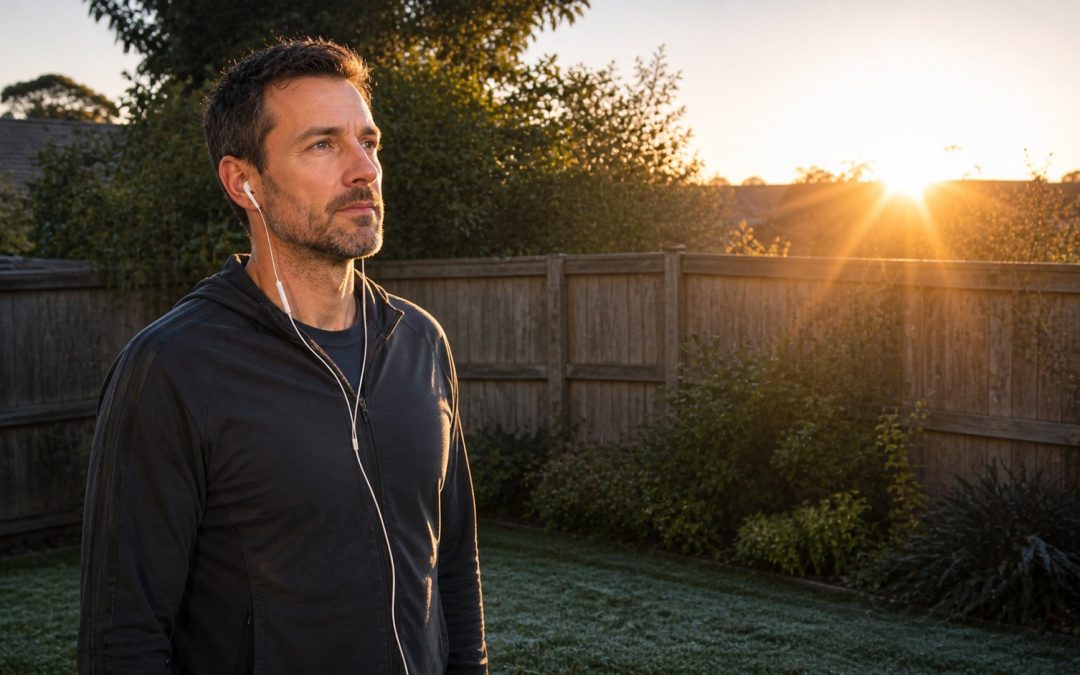
Before my son woke up, before the neighbours were outside, I slipped out the back door into the garden, put the earphones in, faced east, and started. Warm-up, stretches, the sequence. The air was around ten degrees, the sun just clearing the horizon and hitting me directly. Fifteen minutes, concentrated, slightly ridiculous, completely private. Then back inside, wake my son, coffee, a proper breakfast, walk to school together.
I didn’t design any of this as a sleep intervention. I designed it as a way to practice without an audience.
Why a morning light routine works for better sleep
Something shifted in the first week. Sleep, which had been unreliable for a long time, started to stabilise. Falling asleep came more easily. Night waking reduced. Getting up in the morning stopped requiring the usual negotiation. Nothing else had changed — same house, same food, same workload. Just fifteen minutes in the garden before sunrise.
It took a few days to understand why, even though I already knew the science.
The body runs on an internal clock that needs daily resetting. Morning light is the primary signal it uses to set that clock — specifically, natural light hitting the eyes in the first hour after waking triggers a cascade of hormonal events that determine when cortisol peaks, when melatonin rises in the evening, and when the body is ready to sleep that night. Consistent wake time reinforces the signal. Morning movement amplifies it further.
I had studied all of this as part of the fitness training curriculum. I just hadn’t connected it to what I was doing in the garden, because the routine felt too small and too accidental to be the explanation.
That was exactly the point.
Why small and consistent beats ambitious and irregular
A proper hour-long run on an empty stomach requires a functioning system to execute well. When sleep is already broken, that kind of session is more stress than signal — it asks more of the body than it can usefully deliver at that stage.
The fifteen minutes worked because it asked almost nothing physically while delivering everything the clock needed: light, movement, temperature, consistency. And one more thing I hadn’t expected — concentration. Because I was practicing a sequence, I had to be present. I couldn’t drift into a mental scroll of the day ahead. That focused engagement at the start of the day turned out to be its own kind of anchor.
This is the part most morning routine advice gets wrong. The goal isn’t an ambitious protocol. It’s a repeatable signal. The body doesn’t need a perfect morning — it needs a consistent one. And consistent has to mean executable even on the days when the previous night didn’t go well, because those are exactly the days when the signal matters most.
If the previous night included waking at 3AM, the 3AM waking guide explains what’s driving that pattern and how morning timing fits into fixing it.
What the routine looks like now
After the exam, the structure changed but didn’t disappear. School finished for both of us, mornings became less fixed, and the choreography sessions gave way to early runs in the summer heat. But the wake time stayed consistent, and the morning light stayed non-negotiable.
Now it’s simpler: bedroom light on immediately, then outside for a few minutes — check the garden, feed the animals, look around. In winter when it’s still dark, a strong indoor light instead. The minimum is always the same: light, movement, outside, early.
Not because it takes discipline to maintain. Because it works, and because the difference between mornings with it and mornings without it is clear enough that skipping it stopped feeling like a reasonable option.
This is also what the wired but exhausted pattern often needs first — not a complex intervention, but a consistent morning signal that gives the nervous system something predictable to orient around. The evening tends to follow the morning more than the other way around.
The minimum viable morning
If you are still tired after what feels like enough sleep, the issue is often not the night itself but the signals surrounding it. The still tired after 8 hours guide covers why duration alone doesn’t produce recovery — and why the state you arrive at sleep in matters as much as how long you stay there.
The morning routine addresses this from the other direction. Instead of trying to improve the night directly, it resets the clock that governs the night. Done consistently, even at a minimal level, it changes what the evening looks like without requiring any direct intervention at bedtime.
The minimum that appears to be enough: wake at a consistent time, get natural light within the first thirty minutes, include some movement however brief, and do this every day including the days after bad nights. That’s it. Everything else is optional.
For a full picture of how morning timing fits into the broader sleep system, the sleep system guide covers how circadian rhythm, sleep pressure and nervous system state work together. If the bedroom environment is still disrupting the morning light signal, the sleep environment guide covers what to adjust there.
If you want a structured way to approach this
The Sleep Reset eBook breaks this process down into a clear, step-by-step system. Instead of guessing what matters, it gives you a framework to stabilise your sleep pattern over a short period.
Frequently asked questions
Does morning light actually improve sleep quality?
Yes, and it is one of the most evidence-backed sleep interventions available. Natural light hitting the eyes in the first hour after waking triggers the hormonal cascade that sets the circadian clock — determining when cortisol peaks during the day and when melatonin rises in the evening. A well-set clock produces more predictable, deeper sleep. The effect compounds with consistency: the more regularly the signal is delivered, the more precisely the rhythm runs.
How long does a morning light routine need to be?
Fifteen minutes of natural light exposure in the first hour after waking appears to be sufficient for most people to produce a meaningful circadian signal. Longer is not necessarily better — consistency matters more than duration. A five-minute walk outside every morning produces better results than a thirty-minute session three times a week, because the clock responds to regularity rather than intensity.
What if it is dark when I wake up in winter?
A bright indoor light — ideally 10,000 lux from a daylight lamp — is an effective substitute for natural light when it is not yet available outside. Position it at eye level and use it within the first thirty minutes of waking. It is less effective than natural light but significantly better than standard indoor lighting, which is typically too dim to produce a strong circadian signal.
Does wake time matter more than bedtime for sleep quality?
For most people, yes. Consistent wake time is the more powerful anchor for the circadian rhythm because it determines when the clock resets each day. Bedtime consistency matters too, but if you can only control one, wake time produces more reliable results. This is counterintuitive because bedtime feels more controllable — but the body’s clock runs forward from the morning signal, not backward from when you decided to sleep.