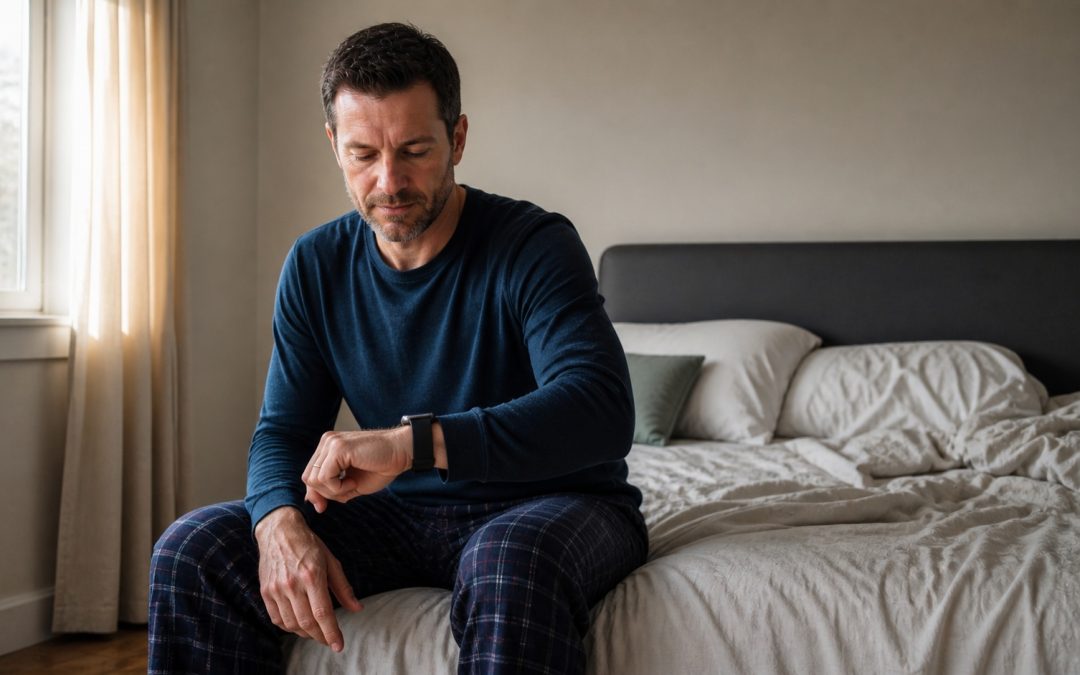
I was sitting in a meeting with the head nurse at the hospital where I was studying to become a rehabilitation therapist. Official documents, administrative details, the usual. She mentioned in passing that there was a flu epidemic going around, half the staff had been through it. I looked completely fine, felt completely fine, but I told her I’d probably caught it too — because my HRV had been dropping for the past few days without any obvious reason.
She laughed. Not unkindly, just the kind of laugh that says: you can’t be serious.
A few hours later I had my first signs of fever. The prediction was right, as it usually is. And because I had already started taking precautions — no training, extra vitamin C, more tea, warmer clothing — what could have been a week of suffering lasted one day in bed and a few days of residual symptoms. My classmates, who hadn’t seen it coming, were down for much longer.
I’ve been tracking my sleep every day for years. Not as an experiment with a start and end date, but as a habit — the same way you might check the weather each morning before deciding what to wear.
What sleep tracking data actually tells you
Whatever device you use, the principle is the same: a quick morning readout that tells you what happened while you were unconscious. Mine shows sleep score, HRV value and the night curve, resting heart rate, body battery, and the daily training suggestion. A rest day recommendation is itself a signal worth reading.
When everything is normal, I barely register what I’ve seen. A minute later I couldn’t tell you the numbers. It’s like a weather forecast that says partly cloudy, mild, no fronts moving in — you note it and move on.
But when something is off, I open the app and go through everything carefully. The numbers that trigger that are specific enough to be useful: if sleep score and HRV have dropped more than twenty percent against the seven-day average, and resting heart rate has increased by more than two beats above average, I treat that as a signal. Light training or none, strict adherence to the sleep rhythm for that day, and a closer look at what’s been stressing the system — physically or mentally.
The next morning is usually back to normal. If it isn’t, that’s when I start paying closer attention to what’s actually going on.
Why the pattern matters more than the number
Most people who start sleep tracking do it because they want better numbers. That’s not quite the right frame.
The numbers aren’t the goal — they’re a language, and what you’re learning to read is your own pattern. Once you know what normal looks like for you specifically, anything that deviates becomes meaningful in a way that generalised health advice never quite manages.
A heart rate two beats above your average is not the same as two beats above a population average. Your body has its own baseline, and that baseline is the only reference that actually matters. This is the same principle behind why the signs of sleep deprivation so often go unnoticed — when you have no personal baseline to compare against, a reduced state starts to feel like normal.
Tracking gives you that baseline. And once you have it, deviation becomes visible rather than invisible.
What early warning actually looks like in practice
What tracking gave me wasn’t optimisation. It gave me early warning and appropriate response.
The flu I caught from the hospital visits was going to arrive regardless of what my watch said. But because the data showed me the dip before the symptoms did, I had a two-day head start on managing it. That head start is worth more than any single night of perfect sleep.
The sickness prediction is the dramatic example, but the quieter version happens constantly. A harder training week, a stressful few days, a run of late nights — all of it shows up in the curve before I consciously register the impact. The watch doesn’t tell me what to do. It tells me what’s already happening, slightly before I would have noticed on my own.
This is particularly relevant to patterns like wired but exhausted — where the body is under load that isn’t yet conscious. The data often catches the nervous system running too high several days before the feeling becomes unmistakable.
The gap between what the body is doing and what we think it’s doing
That gap — between what the body is doing and what we think it’s doing — is where most sleep problems live.
Tracking doesn’t close that gap on its own. But it makes it visible, and visible problems are the only kind you can actually do something about. Without a consistent readout, most people are managing their sleep by feel — which works well enough when the system is running smoothly, and poorly when it isn’t, because a dysregulated system tends to distort the very signals you’d use to notice it.
If the tracking data is consistently showing disrupted sleep despite reasonable habits, the still tired after 8 hours guide covers why duration and quality diverge — and what the data is likely pointing to. If night waking is the recurring pattern in the data, the 3AM waking guide explains the specific mechanisms behind it.
The data from a sleep tracker is most useful not as a score to improve, but as a mirror — showing you the pattern your body is already running, slightly before you would have felt it yourself. Learning to read that mirror is a skill. But once you have it, it changes how you manage everything else.
For a broader picture of the sleep system and what drives the patterns the tracker makes visible, the sleep system guide covers the underlying mechanisms. And if the bedroom environment is contributing to the disruptions showing up in the data, the sleep environment guide covers what to address there.
If you want a structured way to approach this
The Sleep Reset eBook breaks this process down into a clear, step-by-step system. Instead of guessing what matters, it gives you a framework to stabilise your sleep pattern over a short period.
Frequently asked questions
Is sleep tracking actually useful or just another number to obsess over?
It depends on how you use it. Tracking becomes counterproductive when the goal is a perfect score — that tends to increase sleep anxiety, which directly worsens sleep. Tracking is genuinely useful when the goal is pattern recognition: understanding what your normal baseline looks like so that deviations become meaningful signals rather than noise. Used that way, it is one of the more practical tools available for managing sleep and recovery.
What sleep tracking metrics actually matter?
The most useful metrics are those compared against your own seven-day average rather than population norms: sleep score trend, HRV trend, and resting heart rate. A single bad night is rarely meaningful. A three-day downward trend across all three metrics is worth acting on. Body battery or readiness scores can also be useful as a single composite signal if you prefer not to interpret multiple numbers.
Can a sleep tracker detect illness before symptoms appear?
In many cases, yes. HRV in particular tends to drop one to three days before overt symptoms of infection appear, as the immune system begins responding to the pathogen. Resting heart rate often rises at the same time. This is not diagnostic — a tracker cannot tell you what is causing the deviation — but it can indicate that the system is under load, which is enough to prompt a precautionary response.
How long does it take to establish a useful baseline with sleep tracking?
Most devices need two to four weeks of consistent data before the personalised averages become reliable. During that period, avoid drawing strong conclusions from individual nights. After four weeks, you have enough baseline to make deviations meaningful — and that is when the tracking starts producing genuinely useful information rather than just numbers.