

Most men who notice their sleep changing after 40 assume something is wrong. They’re sleeping the same hours, sometimes more, and waking up less rested than they did a decade ago. The 3am wake-ups become familiar. The feeling of lying in what should be sleep but isn’t quite — present but not restoring anything — starts to feel normal.
Deep sleep after 40 does get shorter. That part is real, predictable, and worth understanding clearly — not to catastrophise it, and not to minimise it either. This is what’s actually happening, and what the evidence suggests you can do about it.
What changes in sleep architecture after 40
Sleep moves through cycles of roughly ninety minutes, each containing lighter sleep, REM, and slow-wave deep sleep. Slow-wave sleep — sometimes called deep sleep or N3 — is the physically restorative phase. Growth hormone releases during this stage. Muscle repairs. The immune system does its maintenance work. It clusters in the first half of the night, which is why the first few hours of sleep are disproportionately important for physical recovery.
After 40, the proportion of each cycle that reaches genuine slow-wave sleep decreases. The threshold for waking during lighter phases also lowers. This combination means that the same external disturbance — a sound, a temperature shift, a full bladder — that you slept through at thirty now wakes you at forty-five. The architecture has changed. The buffer between light sleep and full wakefulness is thinner than it used to be.
This shift is driven by hormonal changes that affect sleep architecture directly, and by changes in adenosine sensitivity — the system that builds sleep pressure through the day. According to the Sleep Foundation, slow-wave sleep can decline significantly between the ages of 35 and 55, with the steepest compression often occurring in the mid-forties. The result is that the deep sleep you’re getting is real and necessary — but there is less of it, and the lighter phases surrounding it are lighter than they were.
Why most attempts to fix it don’t work
The typical response to noticing worse sleep is to try to add more of it. Earlier bedtimes. Longer nights. Supplements marketed at deep sleep. Some of these help at the margins. None of them restore the architecture to what it was at thirty-five, because that architecture is no longer available in the same form. The goal shifts from restoration to optimisation of what remains.
The second common response is to treat every variable as equally important. No screens, cooler room, magnesium, weighted blanket, sleep tracking — applied simultaneously and evaluated over days rather than weeks. When sleep doesn’t improve immediately, the conclusion is that the approach doesn’t work, rather than that the structure never had time to establish itself. Understanding the problem is not the same as having a system that addresses it — and without a system, individual changes rarely hold.
The third and most common response is to accept the decline as fixed and stop trying to influence it. This one costs the most, because the architectural shift is real but it is not the whole story. The conditions surrounding sleep — what happens in the sixteen hours before it — have a significant and underestimated effect on how much deep sleep occurs and how reliably it occurs. Building a system that holds through disruption is a different problem from finding the right individual habit.
What actually protects deep sleep after 40
The principle that matters most is timing — specifically, letting the sympathetic nervous system finish its work early enough that the parasympathetic system can take over before sleep. Hard training, mentally demanding work, significant eating and drinking — these all sustain sympathetic activation. When they happen late in the day, the body is still processing them when sleep arrives, which compresses the early slow-wave phase and increases the likelihood of waking during lighter cycles later.
The structure that consistently produces better deep sleep scores — verified over years of tracking — looks like this: physical training in the morning, mental load front-loaded before noon, eating and drinking substantially finished by early afternoon, the second half of the day progressively quieter. Walking, easy movement, reading, genuine wind-down. The evening isn’t where sleep quality is determined — the morning and early afternoon are. By the time sleep arrives, the system isn’t still finishing the day’s work. It can move directly into restoration.
Caffeine timing matters more than most men realise at this stage. The adenosine sensitivity changes that compress deep sleep also mean that caffeine consumed in the afternoon interferes with the slow-wave phase more than it did at thirty. Earlier cutoffs, and lower total intake later in the day, are not optional refinements. For many men over 40 they are the single most recoverable variable available. The mechanism behind caffeine’s effect on sleep depth is worth understanding properly.
How to read your tracking data correctly
Sleep tracking is useful after 40 specifically because the subjective experience of sleep becomes a less reliable signal. A night that felt light may have contained adequate slow-wave sleep in the first cycles. A night that felt complete may have been fragmented in ways the subjective experience didn’t register. Tracking adds an objective layer that subjective experience alone cannot provide — but only if you know what you’re reading.
The number to watch is not the absolute score but the relationship between inputs and outputs. A sleep score that has declined from eighty-five to seventy-two between the ages of thirty-eight and forty-six is not necessarily a sign that something is wrong. It may simply be a sign that the baseline has shifted. What matters is whether a well-managed day — training done early, load front-loaded, eating finished, genuine wind-down — reliably produces a better night than a poorly managed one. If that relationship holds, the system is working. If it doesn’t, something specific is disrupting it and is worth identifying.
The deep sleep got shorter. That part is true and worth knowing. The conditions that determine how much of what remains you actually access — those are still largely within your control. Mental load left unresolved at bedtime is one of the most common reasons deep sleep fails to arrive on schedule.
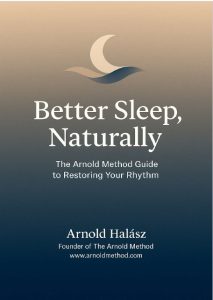
If you want a structured way to approach this
The Sleep Reset eBook breaks this process down into a clear, step-by-step system. Instead of guessing what matters, it gives you a framework to stabilise your sleep pattern over a short period.
Frequently asked questions
Is it normal for deep sleep to decrease after 40?
Yes — slow-wave sleep naturally compresses with age, with the most significant changes often occurring between 35 and 55. This is a documented shift in sleep architecture, not a disorder or deficiency. The goal after 40 is not to restore deep sleep to what it was at thirty but to protect the conditions that allow whatever deep sleep remains available to occur without unnecessary interruption.
How much deep sleep should a man over 40 get per night?
General guidelines suggest 1-2 hours of slow-wave sleep per night, but individual baselines vary significantly and decline with age. More useful than a target number is tracking whether your deep sleep is consistent with your inputs — a well-managed day should reliably produce more restorative sleep than a poorly managed one. If that relationship isn’t holding, something specific is disrupting it.
Can you increase deep sleep after 40?
You cannot restore the sleep architecture of your thirties, but you can meaningfully influence how much of the deep sleep that remains available you actually access. The most recoverable variables are timing-based: training load completed early, caffeine cutoff moved earlier, eating finished several hours before bed, and a genuine parasympathetic wind-down in the final hours of the evening. These don’t add deep sleep so much as remove the conditions that suppress it.
Does caffeine affect deep sleep more after 40?
Evidence suggests yes — changes in adenosine sensitivity that accompany midlife mean caffeine consumed in the afternoon interferes with slow-wave sleep more than it did at younger ages. Many men over 40 find that moving their caffeine cutoff significantly earlier — to noon or early afternoon rather than mid-afternoon — produces a noticeable improvement in sleep depth and morning recovery scores, even without changing anything else.