Somewhere in my forties I noticed that the reference point for most of my decisions had always been outside me. Status, what other people thought, what I assumed they expected from me. Turning fifty didn’t suddenly change that, but it made the direction obvious. Over the last decade, that reference point has slowly moved inside. How I feel about a choice. What I actually value. Whether I want something, rather than whether it looks like something I should want. This is what turning 50 taught me, more than any single event did.
A Picture I Hadn’t Drawn
I probably cared too much about what other people needed and thought. Coming from a family that didn’t have much money didn’t help. I wanted the visible things — mostly cars — and spent more than I should have trying to keep up with a version of life that looked successful from the outside. By my forties I had a good job, a small son, I was racing, driving and riding things that looked good. But when I look back at that period, a lot of it doesn’t feel like mine anymore. I wasn’t exactly unhappy. I was just very good at fitting myself into a picture I hadn’t really drawn.
Money and Boundaries First
The first real crack in that picture came from my son. I wanted to show him a life worth following, and somewhere in there I had to admit that the life I was actually living wasn’t quite the example I wanted to give him. That changed some very ordinary things first: how much money I spent, how easily I let people cross boundaries, how much I needed to show that I was doing well, and how little attention I sometimes paid to my own health. The bigger changes came later. Money and boundaries came first. Real self-control and taking responsibility for my own choices took longer, and were probably a consequence of those first two rather than something I understood at the beginning.
Then came family problems, COVID, and eventually leaving a corporate job I’d had for years, and somewhere in that stretch I found my way back to something I’d studied at university two decades earlier and mostly left behind: psychology. I spent years reading, watching, learning, trying to understand myself better and, slowly, putting boundaries in places where I should probably have put them twenty years earlier. None of that is particularly unusual. What’s unusual is how long it took me.
Two Different Kinds of Hard
I only really understood something else about myself recently. My living costs are modest enough now that I don’t need to spend all my time earning, which gives me a strange amount of freedom to learn. Learning is easy for me. I’ve always been good at it, and I genuinely enjoy it. Doing something where I don’t already know what I’m doing is different. Building something from nothing, putting something out where people can ignore it, starting without somebody else telling me what the goal is — that’s much harder. Years in corporate work had made me very good at reacting to problems and delivering what was expected. Starting something because I wanted it was a different skill.
That’s probably why training for an Ironman this summer isn’t particularly difficult for me, even when the training week goes over twenty hours. Long rides, hard runs, swimming for hours — I know how to do those things, and I mostly enjoy doing them. Starting this newsletter has been much harder. I’m writing in a language that isn’t mine, most days nobody reacts, sometimes the reaction isn’t positive, and more than once I’ve lost motivation and continued anyway — for something that isn’t paying my bills and has no boss waiting on the other end of it. That’s probably exactly why it matters to me.
What a Day Looks Like Now
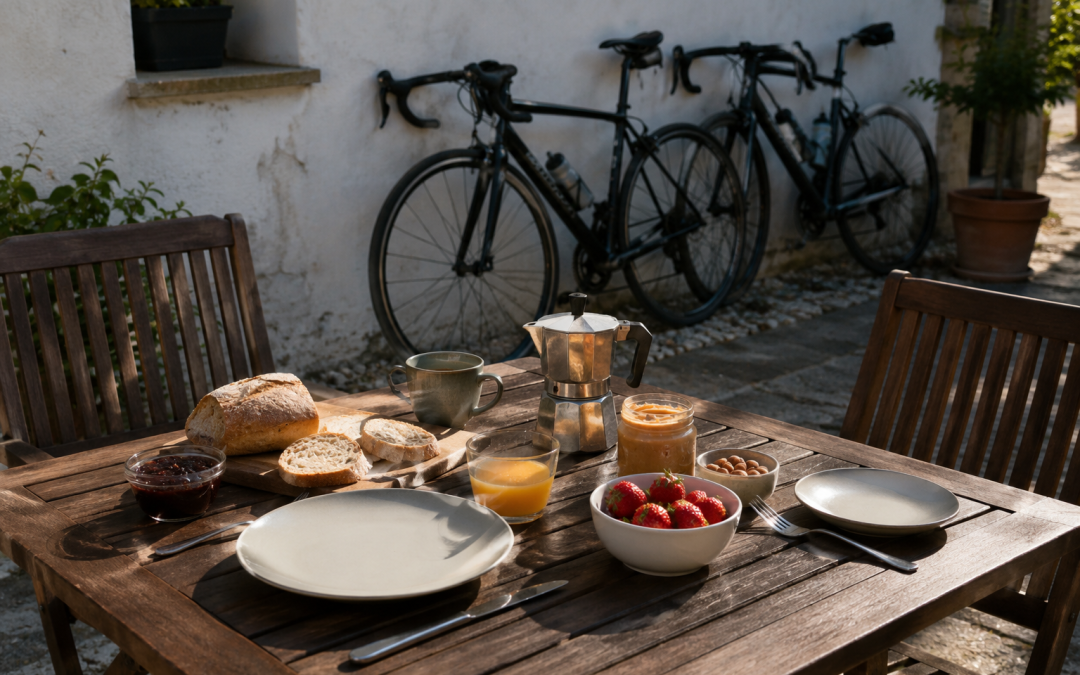
My days now look very different from the ones I used to think were successful. Breakfast with my son, a ride or a run — sometimes he comes with me — food, then a few hours working on this. Some days it’s an hour. Some days it’s most of the day. When my son has his own plans, I’ll sometimes leave for a day or two and go somewhere new. I’ve noticed that I need new places and new impressions fairly regularly. Some people feel better when every day looks familiar. I seem to work better when it doesn’t. I don’t think either is the right way. It’s just what I’ve learned about myself.
The strange part is that I’m grateful for some of the things that made this necessary. The bad decisions, the years spent trying to look like I was doing well, the jobs I eventually didn’t want, the periods when I didn’t take very good care of myself — none of them were useful while I was in them, but they made it harder to keep pretending later. Eventually I had enough evidence that the life I was building for other people’s approval wasn’t the life I actually wanted.
I wish I’d understood that in my twenties.. I didn’t, and I’m not sure anyone could have convinced me then.
What I know now is much simpler. Most of the people I spent years imagining were watching me weren’t watching nearly as closely as I thought. They had their own problems, their own ambitions, their own version of what a successful life was supposed to look like. And the people who actually matter don’t need me to live according to their version of it.
I’ve spent almost five decades learning that.
Better late than never.
If you want a structured way to approach this
The Sleep Reset eBook breaks this process down into a clear, step-by-step system. Instead of guessing what matters, it gives you a framework to stabilise your sleep pattern over a short period.
Frequently asked questions
Is it common to reassess your life priorities around age 50?
Yes — this kind of reassessment shows up often around major life transitions, and turning 50 is a common trigger point, though it’s rarely the cause by itself. It usually surfaces something that’s been building for years.
What does having an internal versus external locus of control actually mean?
It describes whether someone attributes outcomes in their life mainly to their own choices and actions (internal) or to outside forces, circumstances, and other people’s expectations (external). Psychologists generally associate a more internal locus of control with greater resilience and life satisfaction, though it isn’t a fixed trait and can shift over time.
Why does setting boundaries with family or old friends feel so difficult?
Long-standing relationships often settle into patterns that benefit from one person staying the same, so changing the pattern can create real friction, even with people who care. That difficulty is common and doesn’t mean the boundary is wrong.
Can starting something difficult and unrewarded, like a new creative project, still be worth doing?
For many people, yes — doing something entirely by choice, without external pressure or guaranteed reward, can build a different kind of satisfaction than achievement tied to a job or public recognition. It’s a different kind of hard, not a lesser one.