

I got home late after a team ultra running event — three hours of driving after a full day of running in relay, eating at checkpoints whatever was available, a small beer in the afternoon, more food than I needed too late in the evening. By the time I was back, I was tired and wired simultaneously, body beaten up, sleep nowhere near what it should have been.
But the morning after, the anchors were still there. Wake time, light, outside within the first half hour. Not perfect, not the full routine — just the frame. And the frame held, even when everything inside it was slightly off.
That’s what sleep habits that actually stick look like. Not a pristine sequence of optimal choices, but something with enough structure that life can move through it without breaking it entirely.
Why understanding sleep isn’t the same as building a system around it
It took about a decade to build that. Not because the knowledge wasn’t there — the mechanisms were understood earlier than they were applied — but because understanding something and building a system around it are completely different things.
Motivation gets you started. Discipline carries you for a while. Neither of them is enough. What actually holds is a set of anchors so embedded in the day that returning to them after disruption requires less effort than abandoning them entirely.
This is also what most sleep advice misses. It targets knowledge and intention — here is what you should do, here is why it works — without addressing the gap between knowing and doing. That gap is not filled by more information. It is filled by repetition until the anchor is cheaper to maintain than to drop.
The sleep system guide covers the mechanisms behind sleep regulation. This article is about something different: what it actually takes to make those mechanisms part of how a day runs, not just something you attempt when sleep becomes a problem.
What the anchor system actually looks like in practice
The anchors are simpler than the full routine suggests. Wake time consistent, around 6am, without an alarm. While still in bed and dark, two quiet things: close whatever the night left open, and remind myself of the day’s shape — not the details, just the priorities. What actually matters today.
Then full bright light on immediately, bed made, bedroom left within a minute and not returned to until eight in the evening.
Within the first half hour, outside. Always. Cold, rain, the balcony if nothing else. The body needs that signal and the day runs better when it gets it early. Some mornings I still negotiate with it internally. I go anyway.
The rest of the day front-loads what matters. Hardest training in the morning, most demanding mental work between nine and ten, the big meal at midday. Caffeine weighted toward the first half — last real coffee at noon, something weak around two at the latest. Food finished by four.
Not because the rules say so, but because experience showed what happens when they slip: the evening gets harder, the wind-down takes longer, the night costs more. The caffeine and sleep guide covers exactly why the timing matters more than most people expect — and the morning light guide explains why the first half hour outside has an effect that runs all the way to the following night.
What the evening close-down actually involves
From eight onwards the house dims. Screens close, pace drops, the last small tasks get finished quietly. Then the bedroom — dark, cool, simple — and before sleep the same practice every night: a quiet list of what the day actually contained.
Not what it should have contained, not what tomorrow needs. Just what happened, honestly accounted for.
Nothing has ever been solved during ruminating hours in the night. The problems that feel urgent at ten pm are still there at seven am, unchanged — except that one version of you is rested and the other isn’t.
That mental close-down is probably the most transferable part of the whole system, for anyone whose days look nothing like mine. Bedtime consistency, morning light, front-loading caffeine and food — all of these help significantly. But the evening inventory, the honest accounting of what was done and the deliberate decision to leave everything else until morning — that’s available to almost anyone, regardless of schedule or circumstance.
The full reasoning behind why that practice works — and where it came from — is in the guide on stopping mind racing before sleep. The short version: giving the evaluating mind a defined finishing point is more effective than trying to relax it into submission.
The difference between a perfect routine and one that actually holds
Some days the timing goes wrong anyway. Emotional evenings push dinner later. Weekends loosen the edges. A journey that runs long means arriving wired when the wind-down should already be underway.
This is not a system that prevents disruption. It is a system that survives it. The difference matters.
When the remote work pattern removes daily structure, or when the wired but exhausted state has been running long enough to feel normal, the anchor system is what makes recovery possible — because there is something specific to return to rather than a vague intention to sleep better.
The structure is not the constraint. A stable frame running quietly underneath everything else is what makes the rest possible — the work, the training, the time that actually matters. Without it, those things don’t disappear. They just cost more than they should.
Research on sleep hygiene and long-term habit formation consistently points to consistency rather than perfection as the mechanism behind sustainable sleep improvement. The anchors work not because they are optimal on any given day but because they are present on most days — and present is enough.
The system doesn’t need to be unbreakable. It just needs to be worth coming back to.
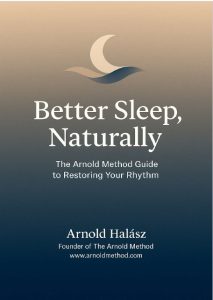
If you want a structured way to approach this
The Sleep Reset eBook breaks this process down into a clear, step-by-step system. Instead of guessing what matters, it gives you a framework to stabilise your sleep pattern over a short period.
Frequently asked questions
What sleep habits actually stick long term?
The habits that last are anchors — small, consistent actions so embedded in the daily pattern that maintaining them requires less effort than abandoning them. Consistent wake time, morning light exposure within the first half hour, a defined end to the working day, and a brief evening inventory before sleep. These work not because they are complex but because they address the fundamental signals the body uses to regulate its rhythm. Perfection is not the goal. Presence is.
How do I get back on track after my sleep routine is disrupted?
Return to the anchors, not the full routine. After a disrupted night or a run of disrupted days, trying to immediately restore the complete system tends to add pressure that further destabilises sleep. Instead, lock in the one or two anchors that matter most — consistent wake time and morning light — and let the rest follow over the next few days. The frame holds even when everything inside it is slightly off.
How long does it take to build a consistent sleep routine?
The mechanics of a circadian rhythm respond within days to consistent signals. The habit — the point where the anchor requires less effort to maintain than to drop — typically takes four to eight weeks of repetition. The variable is not complexity but consistency: a simple anchor repeated daily embeds faster than an elaborate routine followed intermittently. Starting with one anchor and adding gradually produces more durable results than attempting a complete system change at once.
Is it worth building a sleep routine if my schedule is unpredictable?
Yes, and particularly so. An unpredictable schedule is exactly the condition where anchors matter most — because they provide the minimum consistent signal the body needs to maintain its rhythm even when the rest of the day varies. The goal is not a fixed schedule but fixed reference points: a consistent wake time, a reliable morning signal, a defined close to the day. These can survive significant variation in everything else without the rhythm collapsing entirely.