
Most advice on how to stop mind racing before sleep focuses on the evening — breathing techniques, relaxation methods, screen-free hours. What actually worked came from a completely different direction.
For years I approached race preparation the wrong way.
The drive to the start would take anywhere from three to twelve hours depending on where the race was held. In the early days I’d leave the day before, arrive exhausted from the road, and then lie in an unfamiliar bed too wired to sleep — part nerves, part the physical toll of hours behind the wheel, part the particular alertness that comes from knowing what tomorrow holds. I’d start races already depleted, trying to compensate with adrenaline and stubbornness.
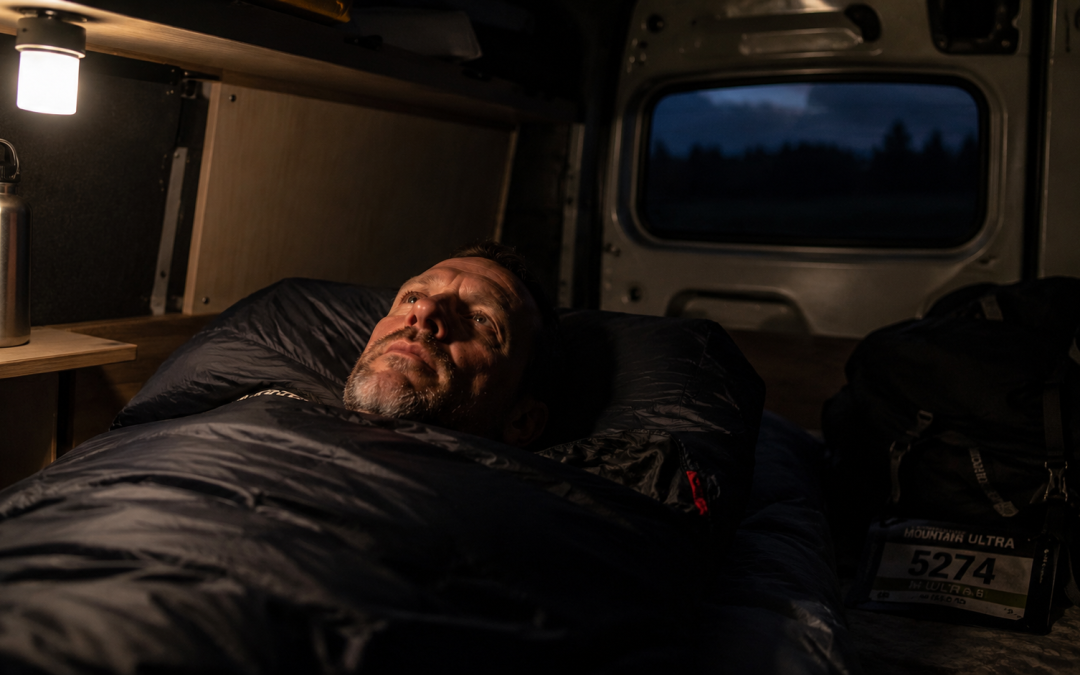
Eventually I changed the approach. Travel two days before instead of one. Arrive with time to check the course, do a short light session to release the travel from my legs, eat well, sleep early. Equipment sorted and deposited the night before so the morning held no surprises. In the later seasons I’d often sleep in a campervan parked next to the startline — not glamorous, but controlled, familiar, and quiet.
The results changed. Not because my fitness improved dramatically, but because I arrived recovered instead of already behind.
Why recovery matters more than training volume
The field I competed in included ex-elite athletes — people whose bodies had been built over decades to absorb punishment and bounce back faster than mine ever would. Trying to match them in training volume and intensity was a losing strategy. I couldn’t out-train them.
What I could do was out-recover them, or at least recover as completely as my own capacity allowed, and show up on race day with nothing left unspent from the preparation.
My best season — the one where I won my age group at both the World and European Championships and the overall World Cup series — was the one where I was most deliberate about recovery. The fitness was already in the body. The only variable left to manage was rest.
On those race days, something happened that I hadn’t experienced much before: my last kilometre of running was often my fastest. Not a survival shuffle to the finish, but an actual acceleration. That’s what a recovered body feels like versus a depleted one. The difference is not subtle.
This is also what the still tired after 8 hours guide points to — the distinction between spending time in bed and actually arriving at sleep recovered. Duration without quality produces the depleted version, not the accelerating one.
The mental practice that started as race strategy
Lying in the campervan the night before a race, I’d go through everything I had done correctly in the preparation. Not what I wished I’d done differently, not what the competition might be doing, not the weather forecast or the course conditions. Just what I had controlled and executed well.
The training sessions completed. The food and fluid managed. The sleep protected. The equipment prepared. I did the work. Whatever happened tomorrow was partly beyond me — competitors, weather, mechanical problems, how the body felt on that specific morning. But my part was done.
That practice migrated into daily life almost without me noticing. Now it happens every night. Not a formal ritual, just a quiet inventory before sleep. One training or activity done. Three aspects of the business moved forward. A good moment with my son. Eating and sleeping as well as the day allowed.
If my average across those things is around seventy-five percent, I sleep well. If it drops below fifty — bad food choices, no training, nothing moved forward, patience worn thin — I remind myself that one bad day does not ruin the sequence of many good ones. Tomorrow is there to correct it.
Why an honest accounting quiets the mind before sleep
If you are looking for how to stop mind racing before sleep, most advice points toward relaxation techniques — breathing, body scanning, progressive muscle relaxation. These are not wrong. But they address the symptom rather than what drives it.
The anxiety that keeps people awake at night is almost always about things they cannot control — tomorrow’s meeting, someone else’s reaction, outcomes that haven’t happened yet. The mind keeps running because it hasn’t resolved the open loop. And you cannot resolve an open loop that depends on the future.
What you can resolve is the past. Specifically, your part in it. Reviewing what you actually did, what was genuinely up to you, and finding it sufficient — that’s not positive thinking. It’s an honest accounting. And when that accounting comes back positive enough, the open loop closes. The mind stops negotiating because there’s nothing left to negotiate.
This is the mechanism behind why the evening sleep routine works differently when it comes from a place of calm rather than anxiety. The stretching is the same. The state you bring to it is not. A resolved mind produces a different physiological result than one still running the day’s unfinished calculations.
Research on anxiety and sleep consistently shows that pre-sleep cognitive arousal — an active, evaluating mind — is one of the primary drivers of sleep onset difficulty. The evening inventory works because it gives that evaluation process a defined end point rather than letting it run indefinitely.
How to apply this if you have never stood on a startline
The racing context is specific but the principle is not. Anyone who has lain awake replaying the day or pre-running tomorrow already knows what an unresolved evening inventory feels like. The mind doing that work at midnight is doing it because nobody gave it a better time.
The practice is simple enough: before sleep, run a quiet review of what you actually controlled that day and executed adequately. Not perfectly — adequately. Training done, or movement of some kind. Something moved forward in work or a project. One decent interaction. Food and sleep managed reasonably. If most of those are present, the accounting is positive. If they are not, note what tomorrow can correct, and close the loop there.
The goal is not to manufacture satisfaction. It is to give the evaluating part of the mind a defined finishing point — because without one, it will keep running until something external stops it, and that something is usually exhaustion rather than resolution.
If the mind is running at night partly because of unresolved physical patterns — waking during the night, feeling unrestored despite enough sleep — the 3AM waking guide and the wired but exhausted guide cover what is driving those patterns physiologically. The mental and physical sides of sleep tend to reinforce each other — addressing one without the other often leaves the system partially stuck.
For the broader picture of how sleep regulation works and what it takes to stabilise the system, the sleep system guide covers the underlying mechanisms. And if the morning routine is not yet in place — which sets the conditions that make the evening inventory easier to close — the morning light guide is the natural starting point.
If you want a structured way to approach this
The Sleep Reset eBook breaks this process down into a clear, step-by-step system. Instead of guessing what matters, it gives you a framework to stabilise your sleep pattern over a short period.
Frequently asked questions
Why does my mind race when I try to sleep?
The most common cause is unresolved cognitive arousal — the evaluating part of the mind continuing to process the day’s events and tomorrow’s demands without a defined end point. This is a normal function of the brain, not a malfunction. The problem is timing: without a deliberate closing practice, the mind defaults to doing this work at the quietest available moment, which is often when you are trying to sleep. Giving it a structured earlier time to complete that process — an evening inventory of what was done and what can wait — tends to reduce the frequency and intensity of late-night mental activity.
Does pre-sleep anxiety affect sleep quality?
Yes, significantly. Cognitive arousal before sleep raises cortisol and keeps the nervous system in a more activated state than sleep requires. This delays sleep onset, reduces the proportion of deep slow-wave sleep in the early part of the night, and increases the likelihood of waking. The physical and mental aspects of sleep are not separate — an active, unresolved mind produces a physiological state that directly interferes with the body’s ability to enter deep recovery.
Is the evening inventory the same as gratitude journalling?
Related but different. Gratitude journalling focuses on appreciating positive things that happened. The evening inventory focuses specifically on what you controlled and executed — which may or may not feel emotionally positive. The goal is not to feel good about the day but to give the evaluating mind a factual, complete account of your part in it. That completeness is what allows the loop to close, regardless of whether the day was a good one.
Can athletes sleep better than non-athletes?
Athletes who manage recovery deliberately tend to sleep better than those who do not — regardless of fitness level. The advantage is not physical capacity but the habits that come from treating recovery as a performance variable rather than a passive background condition. The same principles apply to anyone: consistent timing, deliberate wind-down, managed stimulation, and a practice that closes the day’s mental loop before sleep begins.