

I remember lying on the floor doing my evening stretching routine, trying to relax, and simultaneously worrying about whether I’d sleep lightly again. Which meant the interval training tomorrow would get skipped again. Which meant the whole week’s structure would slip. I was doing the thing that was supposed to help while my mind was already calculating the cost of it not working.
That’s not relaxation. That’s performance anxiety with a foam roller.
For a while I did everything the right way in the evenings. No caffeine after early afternoon, no heavy eating late, no screens. Training moved earlier and kept lighter. The stretching routine every night. It was sensible, and it helped — up to a point. But something stayed inconsistent, and the frustration was worse precisely because I was following the rules.
Where the shift actually came from
The change came from an unexpected direction. A podcast about circadian rhythm and morning light — how specialised cells in the eyes pick up the early light signal and use it to set the body’s internal clock for the entire day. Not the evening. The morning.
The concept made immediate sense, but stayed theoretical for a while. Something to think about, not yet something to live.
The implementation came later, accidentally, during the fitness exam preparation — the cold garden, fifteen minutes of movement, direct sunrise light before my son woke up. I built that routine for completely different reasons and felt the result before I’d consciously connected it to what I’d heard. That’s when theoretical became real.
And that’s when the evenings started to loosen.
The full story of how that morning routine came together — and why it worked — is in the morning light routine guide. The short version: fifteen accidental minutes changed what the evenings required.
What actually changed once the morning was doing its job
When the morning anchor is solid, the evening stops being the primary intervention point. The wind-down happens more naturally because the conditions for it were set hours earlier. You’re not trying to compensate at night for what the morning didn’t do.
The stretching is still there, but its job changed — muscle recovery now, not a sleep ritual. Meditation occasionally, when something genuinely needs settling, not a nightly procedure to earn the right to fall asleep.
The difference sounds subtle but it feels significant. Doing something because it serves your body is different from doing it because you’re anxious about what happens if you don’t.
This connects directly to what drives the wired but exhausted pattern — where the effort to engineer sleep creates exactly the activation that prevents it. The anxiety around the evening routine becomes part of the problem rather than the solution.
The sleep performance anxiety most people don’t name
That anxiety — the low-level performance pressure around sleep — was something I hadn’t fully noticed until it started lifting.
When sleep is broken for long enough, the evening becomes a management exercise. You monitor yourself, run through the checklist, try to engineer the right conditions for something that should happen on its own. The effort itself creates a tension that works against what you’re trying to achieve.
Stopping that wasn’t a decision. It was a consequence. Once the morning was doing its job, the evenings stopped requiring the same attention. More flexible, not careless — just no longer carrying the whole weight.
If the checklist approach has stopped producing results, the still tired after 8 hours guide covers why doing everything right can still leave the underlying system untouched — and what actually needs to change.
Where the real leverage in sleep actually is
Most sleep advice targets the evening because that’s when sleep happens, and working backwards feels logical. But the body’s clock doesn’t run backwards. It sets in the morning. If that’s right, the evening tends to follow.
The leverage was never where I was looking for it.
This is also why the remote work sleep guide focuses on daily structure rather than bedtime rituals — without a morning anchor, no evening routine fully compensates. And why the caffeine and sleep guide focuses on timing during the day rather than what you do in the final hour before bed. The evening is downstream of everything that came before it.
For a complete picture of how the sleep system works — circadian rhythm, sleep pressure, nervous system state — the sleep system guide covers the underlying mechanisms that morning and evening routines are both trying to support.
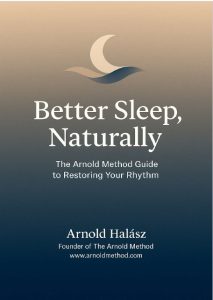
If you want a structured way to approach this
The Sleep Reset eBook breaks this process down into a clear, step-by-step system. Instead of guessing what matters, it gives you a framework to stabilise your sleep pattern over a short period.
Frequently asked questions
Does an evening sleep routine actually help?
Yes, but only up to a point — and with an important caveat. An evening routine helps when it reduces nervous system activation in the hours before sleep. It stops helping, and can actively hinder, when it becomes a performance exercise driven by sleep anxiety. Doing the routine from a place of tension produces a different physiological result than doing the same routine from a place of calm. The routine itself is less important than the state you bring to it.
Why does trying hard to sleep make it worse?
Sleep requires a specific physiological state — low cortisol, rising melatonin, reduced nervous system activation. Effort and monitoring are activation states. When you try to engineer sleep, you are engaging the same systems that keep you awake. The harder you try, the more alert the system becomes. This is why sleep tends to arrive when you stop chasing it — not because of willpower, but because the effort itself was the obstacle.
Is a morning routine more important than an evening routine for sleep?
For most people dealing with inconsistent sleep, yes. The circadian clock sets in the morning through light exposure and consistent wake time. Once that anchor is in place, the evening wind-down tends to happen more naturally without requiring deliberate management. An evening routine is still useful — particularly for reducing stimulation and screen exposure — but it functions best as a complement to a solid morning signal, not as the primary intervention.
How do I stop feeling anxious about sleep?
The most effective approach is indirect: shift focus away from the night and toward the conditions that support sleep during the day — consistent wake time, morning light, managed stimulation, reduced caffeine timing. When those conditions are consistently in place, sleep tends to stabilise on its own, and the anxiety follows. Trying to address sleep anxiety directly, while the underlying system remains dysregulated, tends to keep the anxiety in place because the thing it is worried about keeps happening.