

Why Most Sleep Advice Fails? Many men over 40 with sleep issues have read more sleep advice than they can remember. The wind-down routines, the temperature recommendations, the screen rules, the supplements, the gadgets. Some of it sounded plausible. Most of it was tried. Almost none of it produced the result it promised.
The instinct after enough failed interventions is to assume the problem is personal. That you must be doing it wrong, or that your case is special, or that you simply have bad sleep and have to accept it. The reality is usually simpler. The advice isn’t wrong — it’s calibrated for the wrong reader.
Why mainstream sleep advice is calibrated for the wrong reader
Much of mainstream sleep advice is derived from studies in younger adults or broad general populations whose sleep architecture, hormonal profile, and stress patterns differ significantly from those of a man over 40. The interventions work in those populations because the underlying physiology is different.
Applied to a 47-year-old whose deep sleep has compressed, whose nervous system is carrying genuine load, whose recovery capacity is reduced, the same interventions produce smaller effects or no effect at all. This isn’t a flaw in the research — it’s a mismatch between the demographic generating the advice and the demographic trying to apply it.
The sleep architecture changes that occur after 40 mean that the variables affecting sleep quality are different than they were at 30. Light tolerance changes, caffeine sensitivity changes, hormonal regulation changes, recovery capacity changes. Generic advice that doesn’t account for this rarely moves the needle for the demographic that needs it most.
The single-variable trap that catches most men
The pattern of failure most men experience is consistent. Try one new thing — a supplement, a habit, a piece of equipment — and wait to see if it works. When it doesn’t produce a clear effect within days or weeks, move on to the next thing. Years pass this way without anyone noticing that the pattern itself is the problem.
Sleep doesn’t respond to single interventions because the variables are interdependent. Morning light, caffeine timing, training load, evening behaviour, eating windows, mental load, and dozens of smaller inputs all interact with each other. A single intervention added to a system that isn’t working will rarely produce a visible result, because the limiting factor is usually elsewhere.
The blue light glasses are useless if the underlying rhythm is broken. The magnesium does nothing if cortisol is still elevated at 10pm. The wind-down routine accomplishes little if the day was structured to make sleep impossible from morning onward. This is why understanding individual mechanisms isn’t the same as having a working sleep system. The gap between knowledge and structure is where most men stay stuck.
The melatonin example
Melatonin is the clearest case of the single-variable trap operating at scale. Most men over 40 take melatonin at 5-10mg per night, when the physiologically appropriate dose is roughly 0.3-1mg. At these higher pharmacological doses, melatonin creates sedation rather than supporting natural sleep architecture.
According to research published in the Journal of Clinical Sleep Medicine, commercial melatonin products vary significantly in their actual content — labelled doses can differ by 10-400% from what the bottle states, with substantial variation even between pills in the same container. This means most chronic users don’t actually know what they’re taking on any given night.
Melatonin has legitimate clinical applications — primarily for shifting circadian rhythm during travel or for specific sleep disorders. Chronic nightly use at supraphysiological doses by otherwise healthy adults is not one of them. For most men in this category, melatonin is either solving the wrong problem or creating new ones by suppressing the body’s natural production over time.
The same logic applies to most over-the-counter sleep supplements. They aren’t categorically useless, but they’re almost never the limiting factor. Solving a rhythm problem with magnesium and L-theanine is solving the wrong problem with the wrong tools.
What actually works — systems instead of interventions
The category of advice that moves the needle is different in kind, not just better in execution. It’s not a habit. It’s not a supplement. It’s a system — a coherent set of inputs that work together to produce sleep the body actually wants rather than sleep it tolerates.
Morning light, caffeine timing, training load, evening structure, and mental decompression aren’t separate techniques. They’re components of a single circadian and stress-regulation system that either functions well or doesn’t. Building this system is what produces sustainable change — not stacking interventions hoping one of them will be the missing piece.
What looks like restriction in this framing — earlier caffeine cutoffs, earlier eating, structured wind-downs, consistent wake times — is actually the opposite. The structure produces energy. The rhythm creates capacity. The discipline of building a system is what makes everything else easier, not harder. Most men experience this as a counterintuitive shift the first time they actually do it for long enough to feel the result.
The constraints they expected to feel restrictive feel, after a few weeks, like the foundation that finally lets the rest of life work properly. There is no quick fix because there is no shortcut to building rhythm. The body responds to consistency over time. That is the frustrating truth — and also the hopeful one.
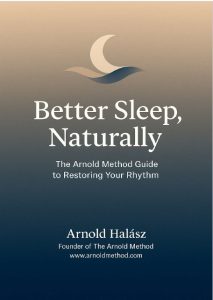
If you want a structured way to approach this
The Sleep Reset eBook breaks this process down into a clear, step-by-step system. Instead of guessing what matters, it gives you a framework to stabilise your sleep pattern over a short period.
Frequently asked questions
Why doesn’t sleep advice work for men over 40?
Most sleep advice is derived from research conducted on younger adults or general populations whose sleep architecture and physiology differ from those of men over 40. After 40, deep sleep compresses, hormonal regulation shifts, and the variables affecting sleep quality become more interactive. Generic advice that targets single variables — supplements, individual habits, specific equipment — rarely produces the promised results because the limiting factor is usually the system, not the variable being targeted.
Is taking melatonin every night safe for healthy adults?
Most healthy adults do not need chronic melatonin supplementation. Common doses of 5-10mg are 10-30 times higher than physiologically appropriate levels of 0.3-1mg, and at these doses melatonin functions more as a sedative than as a sleep architecture support. Commercial melatonin products also vary significantly in actual content compared to label claims. Melatonin has legitimate uses for jet lag and specific sleep disorders, but nightly long-term use in healthy adults trying to fix bad sleep is rarely the right approach and may suppress natural production over time.
What’s the difference between sleep habits and a sleep system?
Sleep habits are individual interventions — an earlier bedtime, magnesium supplementation, blue light glasses, a wind-down routine. A sleep system is a coherent set of interdependent inputs that work together — morning light exposure, caffeine timing, training load distribution, evening structure, mental decompression — all calibrated to support the body’s circadian and stress-regulation processes. Habits added to a broken system rarely produce visible results. A working system reduces the importance of any individual habit because the underlying rhythm is doing the work.
How long does it take to see results from a sleep system approach?
Most measurable improvements require two to three weeks of consistent application before they show clearly in sleep quality and daytime energy. This is longer than most men give individual interventions before moving on to the next attempt, which is part of why single-variable approaches fail. A system requires patience to develop — the body responds to consistency over time, not to any single input. Once the system is established, the daily inputs become near-automatic and the sleep quality compounds rather than fluctuating with each new attempt.