
Sleeping in 28°C: What Heat Actually Does to Your Sleep
Ten years ago, a night on the Danube that didn’t drop below 20°C by sunrise was rare enough to mention. Air conditioning belonged to city apartments, mostly the higher floors. This year some nights don’t drop below 35°C at bedtime at all. By five in the morning it’s sitting at 26. By eight, it’s already past 30.
The climate here has moved enough in a decade that half the sleep habits I built earlier in life stopped being relevant, and I had to rebuild them around a version of summer that didn’t used to exist. The part that took longest to understand is that this isn’t a comfort problem.
Why Heat Blocks Sleep Onset
Falling asleep depends on the core of the body dropping in temperature, usually by less than a degree, and that drop happens mostly through the hands and feet — blood vessels there open up and let heat radiate out into the surrounding air. Research on the temperature dependence of sleep shows this exchange only works if the air around the body is cooler than the skin. On a night where the room is close to body temperature, there’s nowhere for that heat to go, so the drop that triggers sleep either doesn’t happen or happens late.
The sleep that follows sits shallower than it should, with more waking through the night — a shallowing not unlike what I wrote about in why deep sleep gets shorter after 40, just compressed into a single hot night instead of spread across a decade.
The Air Conditioning Trade-off
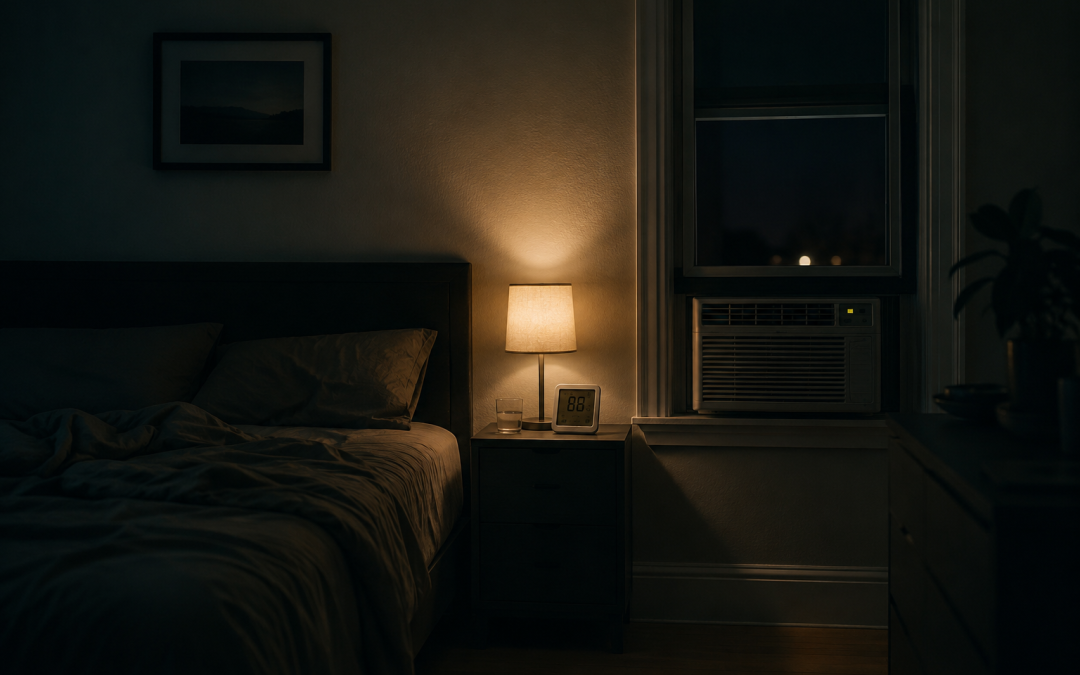
I keep the air conditioning at 25°C rather than pushing it colder, and that’s not restraint for its own sake. Once the room is meaningfully below skin temperature, the exchange that matters is already happening — pushing the thermostat lower doesn’t cool the body any faster, it just costs more to run. This summer that cost isn’t only mine. The national grid has been sitting near its limits on the worst afternoons, and running a unit at 18°C instead of 25°C on a night when half the country is doing the same thing isn’t free in any sense of the word.
Twenty-five degrees does the job the room needs to do. Anything colder is spending power on comfort the body has already gotten — the same unglamorous consistency that outperforms any perfect fix, which is really what the one sleep habit that actually stuck for me turned out to be about.
Restructuring Training Around the Heat
It’s also changed how I train through the hottest stretch of the year. Most sessions now happen off-road, in the forest, starting early enough that direct sun isn’t yet the main problem. The intensity suffers for it — shaded, uneven ground doesn’t let me hold the pace I could hold on open road at seven in the morning in April. I’ve made peace with that trade. An hour of hard running in direct heat costs several hours of recovery and more water than I can reasonably replace mid-session.
The second session of the day, when the afternoon is already pushing 40°C, isn’t running at all — it’s half an hour in the Danube, water still under 25°C, staying in until the body has cooled evenly rather than getting out the moment it feels comfortable. Climbing out too early leaves the skin cool and the core still working through the rest of the heat, which, at least in my experience, doesn’t produce the same settling effect as staying in longer. A slower morning session and a water-based afternoon one move the week forward more than one fast run that ends the day already behind on recovery.
What the Data Changed
The hours before bed still matter regardless of what the room does. Eating within three hours of lying down adds a digestive heat load at exactly the wrong time. Caffeine after noon does something similar through a different pathway, and keeps the nervous system too active to let the temperature drop happen on schedule — the same activation that used to keep my mind running long after the lights were off, before how I use AI to switch my brain off at night gave me something to do with it. A warm shower just before bed helps more than it should, and the reason sounds backward: warm water opens the vessels at the skin, blood moves there and cools, and by the time I’m lying down the body is already partway into the drop it needed to make anyway.
None of this arrived as one bad night that changed my mind. It came from the watch — months of mornings where a hot night showed up as a noticeably lower recovery score, slower return from a training session that wasn’t unusually hard, and a level of dehydration that extra water the day before hadn’t prevented. What my watch tells me every morning has become less about the numbers themselves and more about catching a pattern before I’d trust it as a feeling — the whole gap I wrote about in why understanding your sleep problem isn’t the same as fixing it. That’s mostly what changed from five years ago, when I trained and slept through the heat the same way regardless of what it cost.
The heat isn’t something to push through until it stops being a problem. It’s a variable now, the way rain or daylight always were, and the planning happens around it rather than in spite of it. The bedroom doesn’t determine sleep on hot nights. The day does.
If you want a structured way to approach this
The Sleep Reset eBook breaks this process down into a clear, step-by-step system. Instead of guessing what matters, it gives you a framework to stabilise your sleep pattern over a short period.
Frequently asked questions
Why does a hot bedroom make it harder to fall asleep, not just less comfortable?
Falling asleep depends on the body’s core temperature dropping by roughly a degree, a signal it sends mainly through the hands and feet. If the room is close to body temperature, that heat has nowhere to go, so the drop is delayed or blunted. The result isn’t just discomfort — it’s a later sleep onset and shallower sleep once it arrives.
What’s the best air conditioner temperature for sleeping in summer?
Around 25°C is usually enough to let the body’s natural cooling process work without wasting energy chasing a colder room. Once the air is meaningfully below skin temperature, pushing the thermostat lower doesn’t speed up the process — it just increases the electricity cost, which matters more in regions where the grid is already under strain during heatwaves.
Does a warm shower before bed actually help on a hot night?
Yes, though the mechanism is counterintuitive. Warm water opens the blood vessels near the skin, and once you step out, the body cools rapidly as blood moves toward the surface. That rapid cooling mimics the natural pre-sleep temperature drop, which can make it easier to fall asleep even when the room itself is still warm.
Is it better to sleep in a very cold room during a heatwave?
Not necessarily. Once the room is cool enough for the body to lose heat efficiently, further cooling adds cost without adding benefit. The priority is a room reliably below skin temperature, not the coldest room possible.