
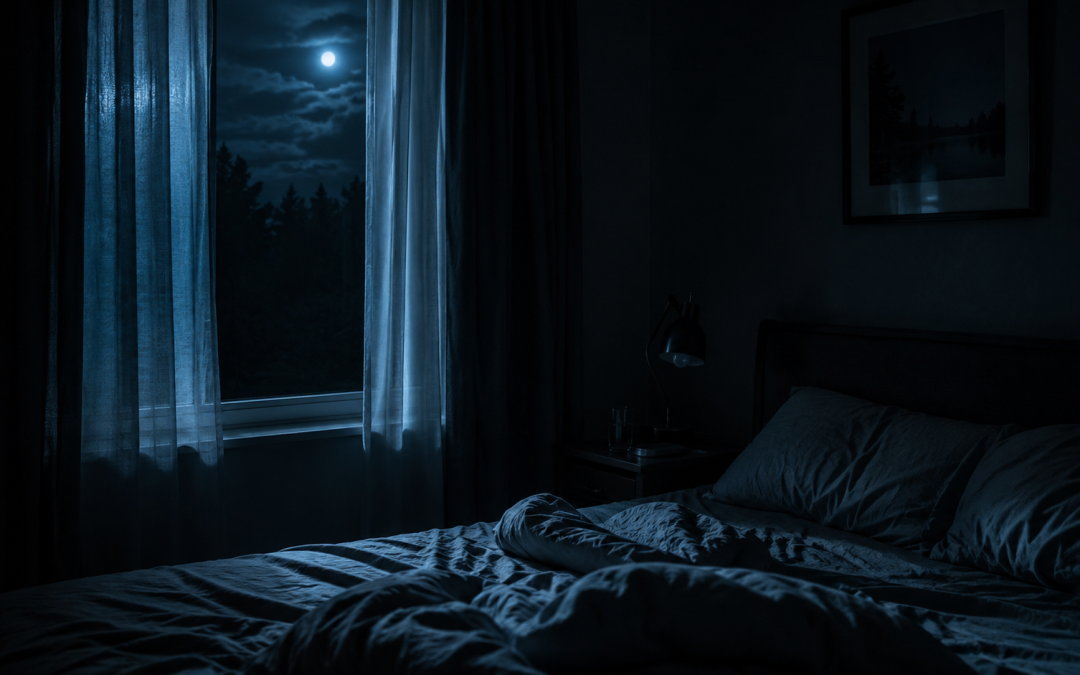
Waking up overheated in the night — damp, heart rate elevated, feet already outside the blanket before you are fully conscious — is one of the most common sleep complaints among men over 40. Most assume it is one problem with one cause. It usually isn’t.
Night sweats in men over 40 can stem from at least three distinct mechanisms, each with a different timing, a different effect on sleep architecture, and a different level of urgency. Telling them apart changes how you respond — and what you stop worrying about.
Pattern one: late eating, heat, and external thermogenesis
The first pattern announces itself before you go to bed. A meal eaten too late, a summer evening where the outdoor temperature hasn’t dropped, alcohol, or food consumed outside the normal feeding window — the body is still processing, still generating heat, still working to stabilise core temperature when sleep is supposed to begin.
Falling asleep is harder than usual because the core temperature drop the body needs to initiate deep sleep is delayed. The first half of the night — where slow-wave deep sleep normally dominates — suffers as a result. The second half often partially compensates once digestion and thermogenesis are complete. The damage is real but bounded, and crucially, it announces itself early. If you know the cause going in, you know what to expect.
The most effective intervention is preventive: eating finished well before the evening removes the most common trigger entirely. A cutoff of four to five hours before sleep eliminates most food-related overheating without requiring anything more complex.
Pattern two: long endurance training and hormonal disruption
The second pattern is subtler and took longer to identify. After long endurance sessions — three or more hours of moderate-intensity running, cycling, or kayaking — a different kind of overheating can appear mid-sleep, with none of the warning signs present at bedtime. Falling asleep is normal. The first part of the night is deep. Then a sudden overheating arrives with a calm mind and no obvious cause.
One plausible mechanism is hormonal. Prolonged endurance work can elevate cortisol, which may temporarily suppress testosterone. Testosterone helps calibrate the hypothalamus — the brain’s internal thermostat — and when levels fluctuate, the thermostat’s tolerance narrows. Small changes in core body
temperature that would normally pass unnoticed start triggering a response. The hypothalamus reads a false signal of overheating, widens blood vessels in the skin producing a flush of warmth, and then activates sweating to cool down what it thinks is an overheated body. You wake up hot and wet — not because you were actually too warm, but because the thermostat misfired. According to research on endurance training and hormonal function, chronic high-volume endurance training is consistently associated with decreased basal testosterone in men, with roughly one in six male endurance athletes showing testosterone levels low enough to qualify as deficient despite otherwise good health.
This pattern seems less common after shorter, more intense work — heavy lifting or sprint intervals — which tends to produce a different hormonal response. Periods of accumulated long sessions without adequate recovery between them raise the likelihood. A well-structured training week with balanced intensity and genuine recovery days reduces it significantly.
Pattern three: age-related thermoregulatory drift
The third pattern has no obvious trigger. No long session the day before, no late meal, no external cause. Just waking mid-sleep, overheated, heart rate elevated, mind completely calm. This is the age-related pattern — the hypothalamus becoming less precise in its temperature regulation as hormonal fluctuations increase through the forties and fifties.
This does not require clinically low testosterone to appear. It reflects a gradual change in the precision of the brain’s thermostat rather than a diagnosable deficiency. It comes occasionally, unpredictably, and tends to become slightly more frequent approaching fifty. The broader shift in sleep architecture that occurs after 40 is part of the same picture — the system becomes less stable, and temperature regulation is one of the places that instability shows up.
Unlike the food-related pattern, this one cannot be fully prevented. It can be reduced in frequency by the same inputs that support hormonal stability generally: training intensity front-loaded in the morning, eating and caffeine finished early, and a genuine parasympathetic wind-down before sleep. But it comes and goes on its own terms.
What the three patterns share — and what they don’t
All three share the moment of waking: overheated, damp, heart rate elevated. What they don’t share is timing, cause, or what the rest of the night looks like.
The food-related pattern damages the first half of the night and cannot be recovered in the moment — the deep sleep that should have occurred in those early hours is already gone. The training-related and age-related patterns disrupt the middle of the night but leave the second half potentially intact. Getting up briefly, cooling down, and returning to bed — the sleep that follows can still be reasonably deep. The overall cost is smaller than it feels at the time.
This is the distinction that matters practically. Night sweats are events you can manage in the moment. The 3am wake-up with a running mind is a different problem entirely — one that requires restructuring the whole day to address. One interrupts the night. The other is the night telling you something about the day. Knowing which one you are dealing with changes what you do about it — and what you stop losing sleep over.
If you want a structured way to approach this
The Sleep Reset eBook breaks this process down into a clear, step-by-step system. Instead of guessing what matters, it gives you a framework to stabilise your sleep pattern over a short period.
Frequently asked questions
Why do men over 40 wake up hot at night?
Night sweats in men over 40 typically have one of three causes: late eating or external heat keeping core temperature elevated into the night; hormonal disruption from prolonged endurance training suppressing testosterone and affecting the brain’s thermostat; or age-related thermoregulatory drift as the hypothalamus becomes less precise in midlife. Each has a different timing and a different effect on sleep quality. Identifying which pattern is occurring changes how you respond to it.
Is waking up hot at night a sign of andropause?
It can be one contributing factor, but it is rarely the only cause. True andropause requires diagnosably low testosterone. What most men over 40 experience is a more gradual age-related change in thermoregulatory precision — the brain’s temperature control becoming less stable as hormonal fluctuations increase. This can produce night sweats without clinical testosterone deficiency. Food timing, training load, and stress are often more immediately recoverable variables than hormonal status.
Does endurance training cause night sweats?
Long, moderate-intensity endurance sessions of three or more hours can contribute to mid-sleep overheating through hormonal disruption — specifically by elevating cortisol, which may temporarily suppress testosterone and affect the hypothalamus’s temperature regulation. This is distinct from the overheating caused by late eating, which tends to affect the beginning of the night rather than the middle. Shorter, high-intensity training sessions appear less likely to produce this effect and may support hormonal stability.
What actually reduces night sweats in men over 40?
The most consistently effective interventions address all three patterns simultaneously: finishing eating four to five hours before sleep, cutting caffeine by early afternoon, front-loading training intensity in the morning rather than the evening, and building a genuine parasympathetic wind-down in the final hours of the day. These do not eliminate the age-related pattern entirely — that one comes and goes on its own terms — but they reduce the frequency of all three and protect enough of the night that when one does occur, the whole night is not lost.