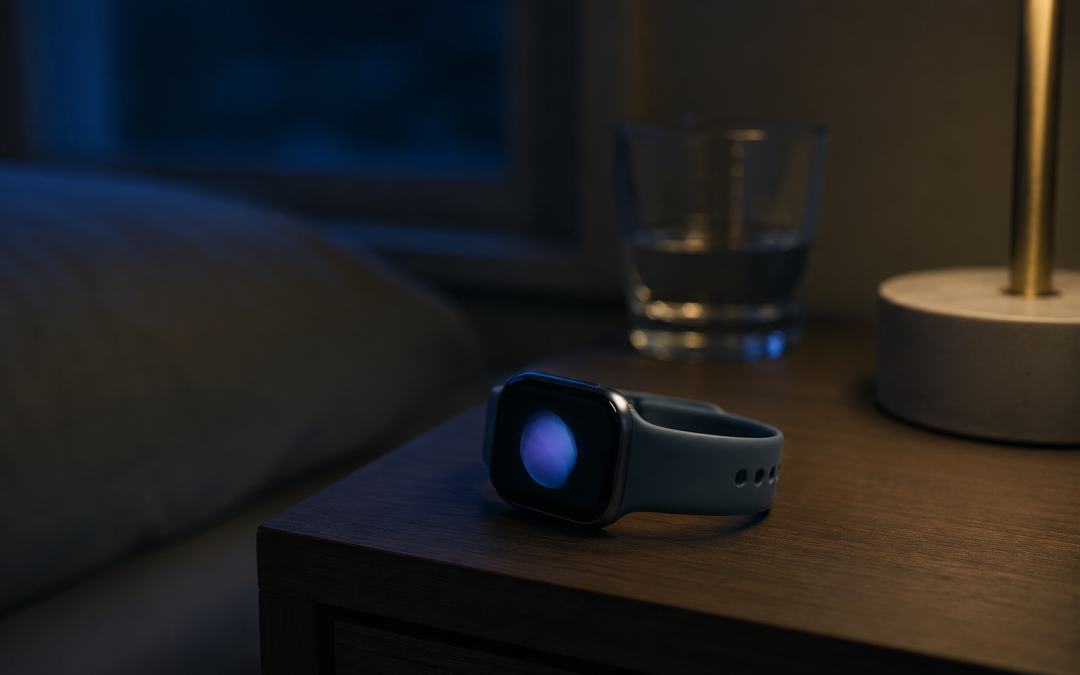
I was exhausted that day. Training had been a bit harder than usual, my appetite was bigger, and instead of doing the one piece of work that actually mattered, I scrolled reels for an hour, half-dreaming about other people’s excitement instead of getting on with mine. By the time I got into bed it was already too late. I woke up sometime around midnight from shallow sleep, thoughts running without going anywhere. Nothing anxious, nothing important. Just noise, my brain still switched on when it should have shut off hours earlier. It was the night I learned something about sleep tracker accuracy the hard way.
The Vanity Number
I lay there and didn’t move my hand. I didn’t want the watch to give me a bad score in the morning. That sounds stupid, and it is, but there’s a vanity to that number — reading it and thinking, good, I’ve done the first thing for my health today, I slept well. This wasn’t the first night I’d done this. It was just the first time I realized the lie was going to cost me the next day.
What It Cost
It did. The watch, tricked by my stillness, gave me a decent score. But it took half an hour to get out of bed that morning — normally it’s under a minute — and running felt impossible before I’d even started. I went anyway. It was painfully slow. My heart rate sat higher than it should have for that pace, and the gap between how hard it actually felt and how hard it should have felt was enormous. I stopped after thirty minutes. Not worth finishing. The lesson wasn’t the bad run. It was that I trusted a number over what I already knew.
The Other Direction
The opposite happens too. Some nights I move more, sleep a little more vividly, and the watch reads it as time awake — but I don’t remember any of it, which for me is always a good sign, and I wake up feeling ten years younger. Training that morning feels too easy, legs fresh, effort not matching output at all. One single reading, in either direction, can be wrong.
Trends, Not Single Nights
A trend is a different matter. During a hard stretch — too much travel, too much training, ordinary life stress piling up — the drift usually isn’t dramatic, just consistently pointed one direction for days. Resting heart rate creeping up, HRV creeping down. That one’s easy to catch. The harder one to catch happens after what I think of as a camper week — a few days away somewhere quiet, like the northern edge of the old Austro-Hungarian monarchy, down in the small mountains of southern Poland. Mornings, an hour of easy exploring on foot. Then hours of cycling from one worthwhile thing to the next, never pushing a climb, just enjoying being there. Whatever’s left of the day, a walk out to some rock the bike couldn’t reach. By evening, the van, somewhere remote, no people, no signal, nothing pulling at me. Days pass like that, and I feel completely relaxed — and don’t notice I’ve actually put in a real training load the whole time: twenty-thousand-plus steps some days, hours in the saddle, almost all of it easy. Everything about those weeks points toward recovery — low stress, easy movement, and usually higher HRV along with it. Which is exactly why it’s hard to start pushing again afterward — I’m tired, and the numbers are the last thing to tell me so.
Sports scientists actually have a name for part of this. Some people are what’s called HRV “non-responders” — their readings don’t reliably drop even when real fatigue is building, which means the exact metric that works well for one athlete can be close to useless for another. I don’t know if that’s me specifically, but it would explain a lot.
For a single day, I trust how I feel over what the watch says. But I don’t make that call before I start. Usually fifteen or twenty minutes into the session tells me which one was right.
If you want a structured way to approach this
The Sleep Reset eBook breaks this process down into a clear, step-by-step system. Instead of guessing what matters, it gives you a framework to stabilise your sleep pattern over a short period.
Frequently asked questions
How accurate are sleep trackers really?
For single-night readings, wearables can be meaningfully off — they infer sleep stages and quality from movement and heart rate patterns, not direct brain measurement, so one bad or misleadingly good night’s score shouldn’t be trusted on its own. They tend to be more reliable when you look at trends across several days rather than any single number.
Can you trick a sleep tracker into giving a better score?
Yes — lying still, even while awake, can produce a better score than what you actually experienced, since most consumer devices rely heavily on movement data. Doing this defeats the purpose of tracking in the first place, since the score stops reflecting reality.
Why would HRV go up during a week when you’re actually getting more tired?
This can happen during periods of low-intensity but high-volume activity, where the nervous system stays in a relaxed, parasympathetic-leaning state even as fatigue quietly accumulates. Some individuals are also known as HRV “non-responders,” whose readings don’t reliably reflect fatigue the way they do for others.
Should you trust how you feel over your sleep tracker data?
For day-to-day training and lifestyle decisions, subjective feeling is often a better real-time signal than a single tracker reading. Multi-day trends in resting heart rate or HRV are still valuable for catching drift that isn’t obvious day to day — the two are complementary, not competing.