
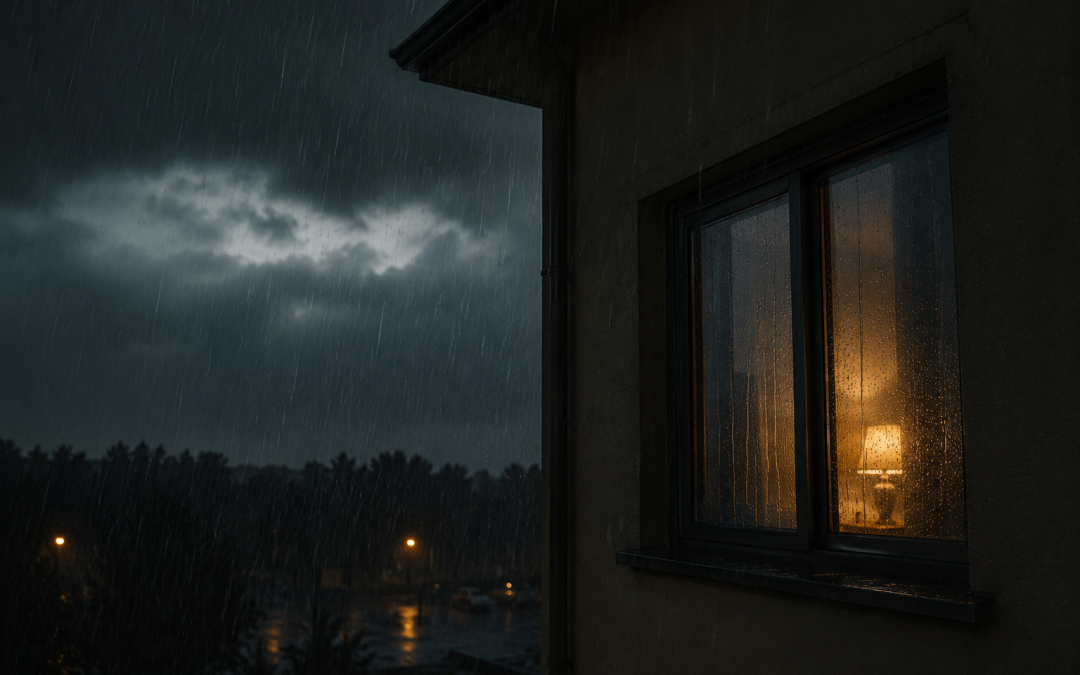
There was no parking near the hotel, so I carried everything I owned for the next three days up a wet street by hand, in rain that hadn’t yet decided whether it was going to be the storm or just the warning for it.
Every decent hotel near the start line in Bydgoszcz had gone to the bigger triathlon happening the same weekend, so what was left for the Quadrathlon World Championship was a small room above a restaurant, with a bed that made no promises about comfort it didn’t intend to keep.
A Storm That Wouldn’t Commit
The storm came in waves rather than all at once, which turned out to be worse. Heavy rain, then a gap where you could hear the restaurant’s cooling unit humming away, then a group of very drunk, very happy strangers who’d decided a thunderstorm was an excellent reason to be loud outside, then the next wave of rain to drown them out, then the unit again. I lay there running the math on a river I’d seen rising on the drive in, on wind strong enough to make the bike leg genuinely dangerous, on a podium finish that had felt within reach for months and now felt like it was being decided by weather I had no say in — the same kind of mind that won’t stop turning a problem over long after there’s anything useful left to think, which is exactly what What Racing Taught Me About Ending the Day was actually about. I’d also driven over twelve hours to get there the day before, so whatever sleep this night was going to offer was starting from a deficit already.
Certain It Was Over — Then the Water Said Otherwise
By morning I’d built a complete case for why the race was already over. Not exhausted exactly — more a specific, quiet certainty that the night had cost me something I wasn’t getting back before the start gun.
Breakfast didn’t change that feeling. Standing at the start line at eight, gear on, rain easing into something more manageable, didn’t change it either. What changed it was the water — cold, properly cold, but clear enough to see the bottom — and the first few strokes into it, when I noticed my arms and legs doing exactly what they’d been trained to do for the better part of a year, with no complaint at all. The race went well. Better than well. Whatever I’d spent the night convinced I’d lost, I hadn’t actually lost it.
What Actually Costs Performance
It took me a few more races to understand why, because the honest answer isn’t “sleep doesn’t matter.” It’s narrower than that. The fitness a short race runs on is banked months before the start line, not built the night before it — the same accounting behind why recovery after 40 has to be built as a framework, not improvised the week of — so one loud, anxious night doesn’t undo it, for me at least. A systematic review of the research backs up at least the timing of it — aerobic endurance performance after one lost night shows only a small effect in morning testing, with the impact growing far larger later in the day, which matches every early-start race I’ve ever anxious-slept through. I know plenty of people find one bad night hits them harder than that, and there’s no reason to assume my experience generalizes to everyone standing on the same start line. Anxious, disrupted sleep before an event is close to universal anyway, not a personal failure worth losing more sleep over. Anyone doing an early-morning Ironman start knows the specific misery of a three or four a.m. alarm and the sleep that never quite arrives the night before it, because you’re lying there running your own version of storm-and-river math about a race that matters to you. That kind of bad night is just what race eve tends to feel like. For me, it rarely shows up in the results.
The One That Does
The exception, and it took losing time in a couple of races to actually notice it, is dehydration. A hot room or a camper van that never properly cools down — the same overheating covered separately in why night sweats happen after 40 — costs you water you can’t fully replace before a start line, and that isn’t the same problem as a noisy hotel or pre-race nerves. It’s a different mechanism wearing the same disguise. Losing that much fluid overnight thins the blood you’re racing on and makes the heart work harder for the same output, before the start gun has even gone off. The finish time on paper often doesn’t move much. What moves is how the effort feels the entire way round, harder at every mile than it has any right to be, and by the run leg — always the run leg — the gap between what the legs can do and what they’re willing to do starts showing up in the pace. That bad night leaves a mark the race can’t fully mask. The Bydgoszcz kind doesn’t — a distinction I only fully trust now that it’s repeated race after race, the same way I’ve learned to trust what my watch tells me only once a pattern shows up more than once.
I still can’t fully explain why a race always goes better than the training leading up to it seems to promise. Some of it is adrenaline, some of it is just standing at a start line and finally having a job to do instead of a storm to worry about. But it’s changed what I actually worry about the night before. Most bad nights are just noise — loud, uncomfortable, gone by the time the gun goes off. One kind is signal. I spent a long time being afraid of the wrong one.
If you want a structured way to approach this
The Sleep Reset eBook breaks this process down into a clear, step-by-step system. Instead of guessing what matters, it gives you a framework to stabilise your sleep pattern over a short period.
Frequently asked questions
Does poor sleep the night before a race actually hurt performance?
Less than most people assume, especially for short, early-morning races. A systematic review of sleep deprivation research found aerobic endurance performance shows only a small decline after one lost night when tested in the morning, with a much larger effect later in the day. The fitness built over months of training doesn’t disappear because of one bad night.
Why do I feel anxious and sleep badly before every race?
Pre-race anxiety disrupting sleep is close to universal among endurance athletes, not a sign of poor preparation. Early start times, unfamiliar accommodation, and the stakes of the event itself all activate the same alertness response that makes falling and staying asleep harder — and it rarely correlates with how the race actually goes.
Can dehydration before a race feel like poor sleep?
They can produce similar symptoms — fatigue, heavier effort, a flat feeling — but the mechanisms are different. Dehydration reduces blood volume and makes the heart work harder for the same output, which tends to show up as a harder-feeling effort and a fading pace later in a race, rather than in how tired you felt that morning.
Does the time of day a race starts change how much sleep loss matters?
Based on the available research, yes. Aerobic endurance performance after acute sleep loss is affected far more in afternoon and evening testing than in morning testing, which may partly explain why early-start endurance events seem more forgiving of a bad night than athletes expect going in.