
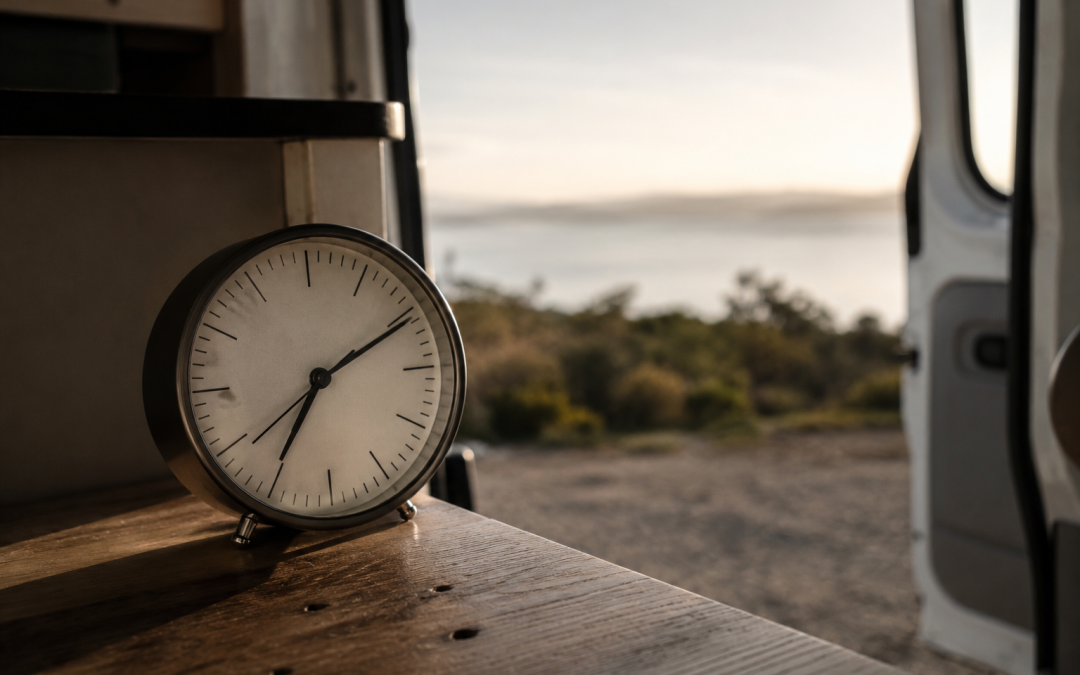
Every plan for a solo trip is provisional except one: a consistent wake up time, and the bedtime that goes with it. I check the forecast the night before I leave, aim for somewhere within about a thousand kilometers where the temperature sits near twenty degrees, and from there almost everything bends once I actually arrive.
I’ve stopped thinking of that as a routine, because a routine is something you choose to keep doing. This is closer to a need — the same distinction that matters in why a focus problem is sometimes actually a sleep problem: naming the real mechanism changes what you do about it.
A Night That Tests It
There are nights it gets tested harder than others — a storm rolling in, the van parked under trees loud enough in the wind to keep sleep shallow rather than actually broken. One year it happened the night before an afternoon race, and the body that’s been kept up half the night by wind and rain wants exactly one thing the next morning, which is more of it. A late start would have been the reasonable call, the kind of excuse nobody would have questioned — the same trade-off I got into separately writing about why sleeping in on weekends costs more than it gives back. I didn’t take it. I woke at the usual time anyway, closer to half past six than to whatever a lie-in would have offered, because keeping the clock steady mattered more to me than the extra hour did, even with a good reason sitting right there to let it go.
No Alarm, No Sun
There’s no alarm involved, and the sun doesn’t decide it either — sunrise moves by the season and the latitude, earlier or later depending on where I’ve ended up, but the time I wake stays fixed regardless of what the sky outside is doing. I wake several times most nights, which is ordinary and not something I fight — not so different from what shows up in why waking multiple times a night becomes more common after 40 — and the day properly starts whenever I stop being able to fall back asleep, reliably somewhere between half past five and six, wherever I am. From there the day gets built around whatever has to happen no matter what, and the weather decides the shape of everything else around it. Too hot, and swimming and cycling take over from running. Rain closes off whatever I meant to go and see, and something indoors takes its place without much thought. None of it costs me anything, because none of it was ever the actual plan. The clock was the plan. A National Sleep Foundation consensus panel reviewing the research came to a similar conclusion — consistent sleep and wake timing tracks with better outcomes across nearly every measure they looked at, independent of how many hours you actually get. The weather just decides what the day looks like underneath it.
It Wasn’t Always Like This
Before this held, I went through long stretches of falling asleep at wildly different times and waking the same way, with a mood that tracked the fluctuation almost exactly — the kind of pattern most generic sleep advice never quite reaches, because it treats the symptom rather than the timing underneath it, which is a lot of what’s actually wrong with why most sleep advice fails for men our age in the first place. Now the timing barely moves, and a short night — seven hours, nothing special — mostly just passes without much of a bill attached, because the one thing it can’t touch is still sitting where it always sits.
What Doesn’t Move
I run the same system with my son around as I do completely alone, which took me a while to notice wasn’t obvious to say out loud. It was never about missing home, or needing something familiar to hold onto somewhere strange. It’s closer to my body keeping a promise to itself, regardless of who else happens to be in the room. The forecast is negotiable. The route is negotiable. My internal clock isn’t.
If you want a structured way to approach this
The Sleep Reset eBook breaks this process down into a clear, step-by-step system. Instead of guessing what matters, it gives you a framework to stabilise your sleep pattern over a short period.
Frequently asked questions
Does keeping the same wake-up time matter more than getting extra sleep?
For overall consistency, often yes. Research reviewed by a National Sleep Foundation consensus panel found that stable sleep and wake timing is linked to better outcomes across alertness, mood, and cardiovascular measures, independent of total hours slept. One short night rarely causes lasting harm; a wake time that moves constantly tends to cause more disruption over time.
Is it possible to keep a consistent sleep schedule without using an alarm?
Yes, once a wake time is stable enough for the body to anticipate it — the internal clock starts triggering natural waking around the same time each day, which is why a fixed schedule eventually needs less external enforcement, not more.
Should I sleep in after a bad night’s sleep to recover?
Occasionally it helps in the short term, but doing it regularly can undermine the consistency that makes sleep reliable in the first place. Holding the usual wake time after a poor night usually costs less than the schedule disruption a lie-in creates.
How can I stay on a consistent sleep-wake schedule while traveling or camping?
Treat wake and sleep time as the fixed points of the day and let everything else — activities, routes, plans — adjust around them instead of the reverse. This holds regardless of time zone, daylight hours, or how unpredictable the rest of the trip is.