

Sleeping in on weekends feels like the obvious solution to a depleted week. Sleep debt accumulated Monday through Friday, the lie-in on Sunday repays it, and Monday arrives at zero. That’s the intuitive version. The biology works differently.
When weekend sleep timing diverges significantly from weekday timing, the circadian clock shifts — producing a form of self-inflicted jet lag that makes Monday harder, not easier. Understanding why changes how you approach the one sleep habit most men never question.
What social jet lag actually is
Social jet lag describes the misalignment between the body’s internal clock and the clock on the wall — specifically the shift that occurs when weekend sleep timing differs significantly from weekday sleep timing. When you sleep ninety minutes or more later on weekends than on weekdays, the circadian rhythm moves forward. The internal signals that regulate alertness, cortisol release, and melatonin production all shift to match the later schedule.
Then Monday arrives. The alarm goes off at the usual time, but the body is still operating on weekend timing. The grogginess that follows is not reluctance or laziness — it is genuine circadian misalignment, the same mechanism that makes eastward travel feel worse than westward. The difference is that social jet lag is self-inflicted and repeated every week, which means the circadian system never fully recovers before the next weekend resets it again.
According to research on circadian biology, social jet lag is associated with worse mood, poorer cognitive performance, increased fatigue, and measurable metabolic effects — particularly in people whose weekend sleep timing diverges by more than ninety minutes from their weekday schedule. The effect compounds over time rather than resolving with each cycle.
Why the connection is so easy to miss
The lie-in feels genuinely restorative in the moment. Waking slowly on Sunday morning, no alarm, no urgency — it registers as rest because it feels like rest. The cost arrives on Monday, which is far enough away that the causal link is easy to miss. And because Monday always feels harder for obvious reasons — the week resuming, the workload returning — the weekend sleep pattern never gets examined. Monday is just Monday.
This delayed cost is what makes social jet lag different from most sleep problems. Most sleep disruptions announce themselves immediately — a bad night produces a bad morning. Social jet lag produces a bad week that gets attributed to everything except its actual cause.
The pattern also feels justified. If the week genuinely depleted you, the instinct to recover through extra sleep is rational. The problem is not the intention but the mechanism — extra sleep at a shifted time does not repay sleep debt without a circadian cost attached.
What actually helps — and what the research actually says
The most consistently effective intervention is keeping wake time within approximately thirty minutes of the weekday version, even on weekends. Not necessarily bedtime — going to bed later on Friday or Saturday is less disruptive to the circadian rhythm than waking significantly later. The morning anchor is the primary clock-setter. Light exposure in the first thirty minutes after waking is the strongest signal the body uses to calibrate its internal clock — if that timing stays consistent, the rhythm stays stable regardless of what happened the night before.
This does not mean deliberately sleeping less on weekends. It means that preserving wake time matters more than most people realise. An extra hour in bed reached by going to bed earlier rather than waking later produces a different outcome — more sleep without the circadian shift.
For men who train seriously, the racing and performance context makes this visible in a way that daily life often obscures. Keeping a consistent wake time before events — even when the previous night was disrupted by travel or nerves — produces more reliable alertness than trying to bank extra sleep. The body responds to the anchor, not the total hours. The same principle applies to every Monday, not just race days.
The practical threshold worth knowing
An occasional longer sleep on a genuinely depleted week, kept within an hour of the normal wake time, causes minimal circadian disruption. The problem is the repeated pattern — every weekend, ninety minutes or more later, week after week — which maintains a state of mild misalignment the system never escapes before the next cycle begins.
The threshold most sleep researchers use is roughly sixty to ninety minutes of divergence between weekday and weekend wake times. Below that, the circadian effect is minimal. Above it, the effect becomes measurable and cumulative. Consistency in wake time is the single most reliable anchor in a stable sleep system — more so than bedtime, sleep environment, or most other variables people focus on.
The weekend lie-in feels like recovery. Often it is just borrowing energy from Monday — pleasant in the moment, paid back with interest at the start of the week.
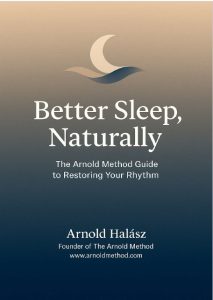
If you want a structured way to approach this
The Sleep Reset eBook breaks this process down into a clear, step-by-step system. Instead of guessing what matters, it gives you a framework to stabilise your sleep pattern over a short period.
Frequently asked questions
Does sleeping in on weekends actually make you more tired?
Not directly — but it shifts the circadian clock forward, which produces grogginess and reduced alertness when the weekday alarm goes off on Monday. The body is still operating on weekend timing. This is called social jet lag, and the effect is measurable in mood, cognitive performance, and fatigue levels through the early part of the week. The tiredness on Monday morning is often a consequence of Sunday’s lie-in rather than the week’s accumulated sleep debt.
How much of a lie-in is too much?
Most sleep research points to sixty to ninety minutes of divergence between weekday and weekend wake times as the threshold where circadian effects become measurable. Below that, occasional longer sleep causes minimal disruption. Above it — particularly when the pattern repeats every weekend — the circadian rhythm stays in a state of mild misalignment that compounds over time.
Is it better to go to bed later or wake up later on weekends?
Going to bed later is less disruptive to the circadian rhythm than waking significantly later. The morning wake time is the primary signal the body uses to set its internal clock — light exposure in the first thirty minutes after waking calibrates the entire day’s hormonal and alertness cycle. Preserving wake time while allowing a later bedtime occasionally produces more sleep without the circadian cost of a shifted morning anchor.
Can you catch up on sleep debt at weekends?
Some recovery of sleep debt is possible through weekend sleep, but the circadian cost of shifting the schedule significantly often undermines the benefit. The more effective approach is reducing the debt accumulated during the week — through earlier and more consistent bedtimes on weekdays — rather than trying to repay it through later weekends. A stable, consistent schedule that accumulates less debt is more sustainable than a cycle of depletion and recovery that never fully resets.